
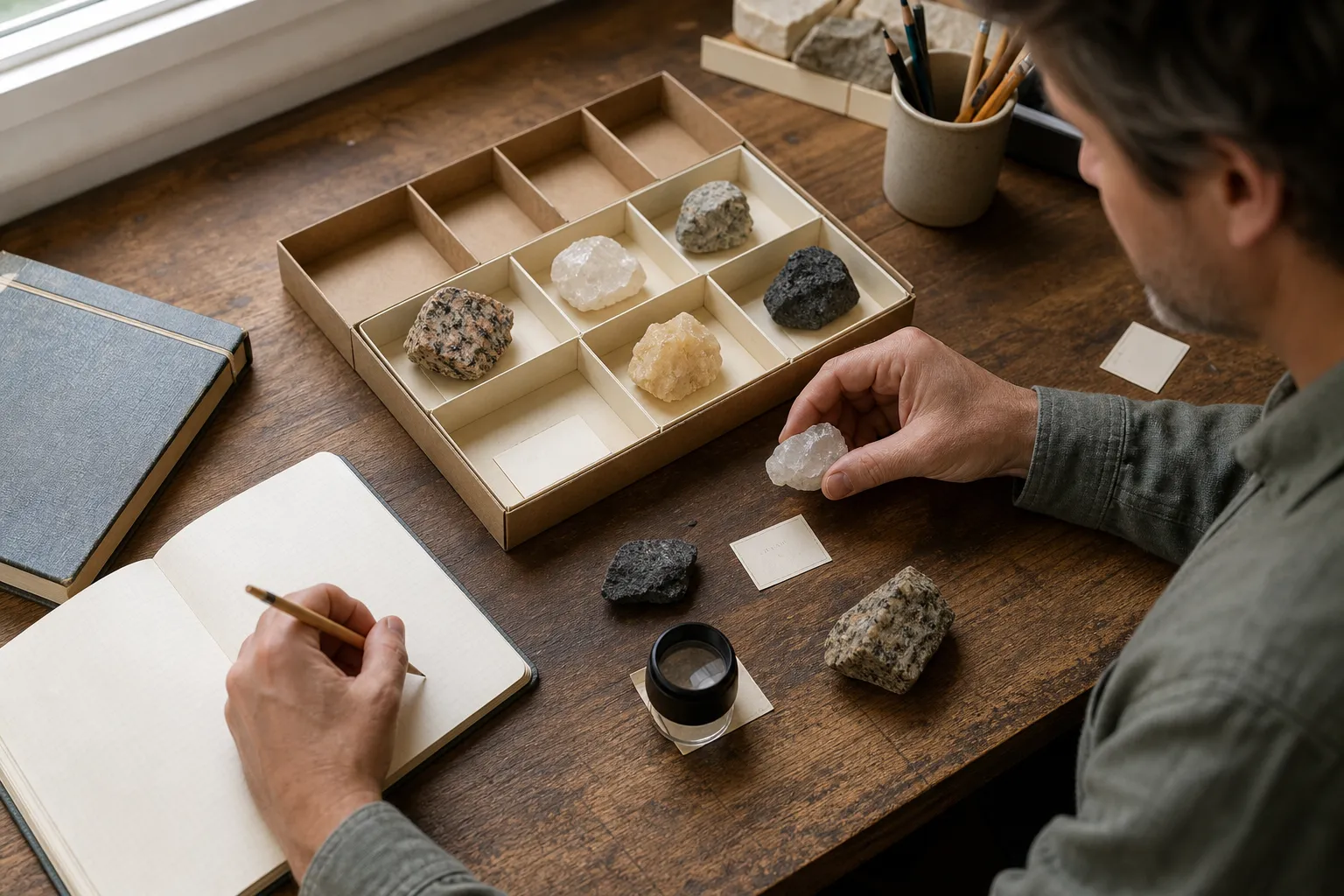
A useful specimen label does more than name a stone. It keeps the object connected to the facts that are hardest to recover later: where it came from, when it was acquired, who collected or supplied it, and how certain the identification really is.
Names can change. A stone labeled “quartz” today may become “chalcedony, probably” after closer examination, or remain honestly unknown. Its source does not change. A good system protects that history while leaving room to learn.
You do not need museum software or tiny calligraphy. You need one stable number, one physical label, and one fuller catalog record for every specimen.
Build three linked parts
Think of the system as a chain:
| Part | Job | Minimum content |
|---|---|---|
| Specimen number | Uniquely points to one object | A short ID such as SS-0001 |
| Physical label | Keeps the ID and essential context beside the object | ID, working name, locality, date, source |
| Catalog record | Holds everything that will not fit on the card | Full locality, notes, photographs, identification history, condition, storage location |
The National Park Service notes that a natural-history label can hold only limited information, so the catalog record remains critical. The U.S. Geological Survey likewise defines a catalog as organized records connected to specimens through unique numbers.
If a card is separated from its tray, the number helps reunite it with the record. If your catalog is unavailable, the card still preserves essential context.
Choose a number that carries no scientific claim
Start at SS-0001 and count upward. The letters can be your initials or a short collection code. Leading zeroes keep digital lists in order. If two family collections may someday merge, different prefixes prevent both from having a “number 42.”
Do not encode the mineral name, price, drawer, or locality into the ID. QTZ-MI-2026-01 looks informative until the “quartz” becomes calcite, the specimen moves to another drawer, or the locality proves less certain. A plain number keeps working.
Give each specimen its own number, including two similar pieces found on the same day. Never recycle the number of a specimen you trade, give away, or lose. Mark the catalog entry as transferred, missing, or removed and record the date. Reusing an ID can attach old photographs and provenance to the wrong stone.
Professional collections may use registered identifiers and barcodes. A home collection usually does not need that machinery. The principle worth borrowing is persistence.
Put only the durable essentials on the card
A tray label might read:
SS-0047
Fluorite?
Dealer label: “Hardin Co., Illinois”
Acquired 2026-08-18 · Local mineral show
The question mark matters. It separates a working identification from a confirmed one. “Dealer label” also matters: it tells a future reader where the locality claim came from instead of presenting it as your own verified field record.
For a specimen you collected, replace the source line with the collector’s name and an accurate locality. For a gift, record the giver and preserve whatever original wording came with it. If the date is approximate, say so. If the locality is unknown, write “locality unknown.” A blank or an honest limitation is better than a polished guess.
The detailed story belongs in the catalog, not in tiny writing on the card.
Record locality before it becomes a memory
Locality gives an ordinary specimen much of its meaning. “Granite” is a name; “rounded granite cobble, lawful surface find, Lake Huron shoreline near Alpena, Michigan” is a record.
For a field find, record the site name, nearest named feature, city or county, state or province, country, date, collector, and any permission or permit reference that applies. Keep precise coordinates in the private catalog when they are useful, but consider whether publishing them could expose private property, a vulnerable site, or a restricted collecting location. The Smithsonian notes that some collection-locality information is restricted for privacy, security, cultural, or preservation reasons.
For a purchase or inherited piece, copy the locality exactly as supplied, including spelling and uncertainty. Do not quietly expand “Brazil” into a mine name found on the internet. The NPS natural-history handbook gives a wonderfully strict rule for incomplete labels: use the collector’s data and do not guess what belongs in the blanks.
Let identification change without erasing history
Keep at least three fields separate in the catalog:
- current working identification: your best present name;
- identification status: unknown, suggested, probable, or confirmed; and
- identification history: the original label plus later opinions, dates, and methods.
Suppose a purchased stone arrived as “green calcite.” Later, its form and hardness point toward fluorite, and a club mentor agrees. Do not rewrite the story. Add “Probable fluorite; reviewed by [name] from crystal form and relative hardness, [date]; original seller label retained.” If the distinction affects value, safety, or a formal claim, ask the appropriate expert or laboratory and record what they examined.
This is especially important for photo suggestions. A photograph can support a ranked shortlist, but it cannot measure hardness, streak, density, chemistry, or internal structure. Put “suggested from photo” in the record rather than promoting the first match to fact.
Choose label materials for the specimen, not the stationery drawer
For most home collections, use clean acid-free, lignin-free card that fits inside the individual tray or box. The Canadian Conservation Institute explains that mechanically processed wood-pulp papers tend to be acidic and short-lived, while chemically processed papers can be neutral or slightly alkaline.
Graphite pencil is resistant to light fading, though it can smudge if repeatedly rubbed. If you use ink, choose a permanent, waterproof pigment ink intended for archival work, test it on the card, and let it dry completely before it goes near the specimen. Avoid ordinary sticky notes, pressure-sensitive tape, rubber bands, staples, and loose labels that can migrate from one compartment to another.
Do not glue a label to a crystal face or wrap a fragile specimen with string. Professional geological collections sometimes mark a small catalog number directly on a robust rock over an isolating conservation coating. The NPS cautions against that approach for powdery, fibrous, flaky, or solvent-sensitive material. Unless you understand the specimen and the reversible marking method, label its dedicated tray or box instead.
Keep any old collector, dealer, or family label even when it is faded, incorrect, or unattractive. The Canadian Conservation Institute treats historical labels as records with their own information and history. Place a fragile detached label in a clear, stable archival sleeve, transcribe it in the catalog, and store it with an unmistakable reference to the specimen.
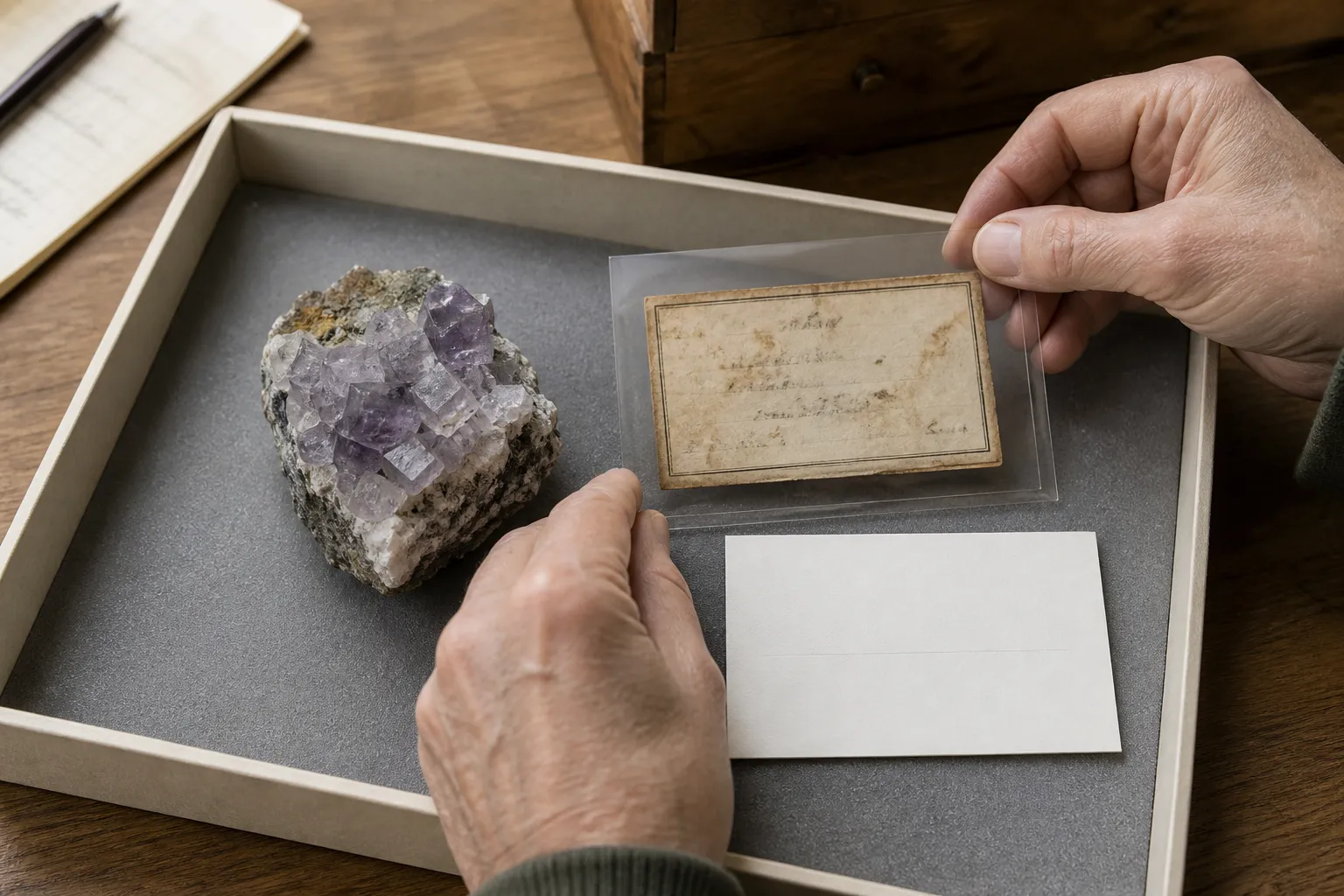
Transcribe an old label; do not replace its evidence. Keep the original protected and physically associated with the specimen.
Make the catalog richer than the label
Your paper notebook, spreadsheet, database, or app should give one row or record to each number. Include:
- specimen number and current working identification;
- identification status and the evidence behind it;
- original label text copied verbatim;
- full locality and who supplied that information;
- collected or acquired date, collector, donor, or seller;
- permission, permit, or purchase reference when relevant;
- dimensions, condition, repairs, coatings, and known treatments;
- photographs and the date they were made;
- current tray, drawer, or shelf location; and
- later identifications, transfers, or condition changes.
Photograph the dry specimen on a plain background, then make one frame that includes the specimen and its ID card. Add close-ups of the features that matter and a clear image of every original label. Our guide to taking better rock-identification photos provides a repeatable setup, but catalog photographs have an extra job: proving which physical object belongs to which record.
Back up a digital catalog somewhere independent of the device that holds the working copy. A paper card plus a backed-up catalog is more resilient than either alone.
Use a seven-step intake routine
Label a specimen before it disappears into the collection:
- Keep the object and every label together in one temporary container.
- Assign the next unused catalog number.
- Copy the original wording exactly and note its source.
- Create the full catalog record, leaving unknown fields unknown.
- Photograph the specimen, number, and original labels together.
- Prepare the physical card and place it in a dedicated tray or box.
- Put the specimen in storage and record that storage location.
If you already have an unlabeled drawer, stop moving pieces between compartments. Photograph the current arrangement, assign numbers one object at a time, and record only what you can support. “Old family collection; locality and date unknown” may feel incomplete, but it preserves the truth and gives future observations a reliable place to accumulate.
StoneScout can hold specimen photos, a custom title, field notes, an identification status, and an optional find location in its searchable collection. Put your stable number in the custom title or at the beginning of the notes so the app record matches the paper card. Keep the original label and an independent catalog copy too. The app is a useful view of the collection; the number-and-label system is what keeps the story attached to the stone.
If you are still deciding what deserves a number, begin with a focused collection rather than an unlimited pile. A label takes only a few minutes. Reconstructing a lost locality can take hours—and often cannot be done at all.
Sources
- Appendix H: Natural History Collections — National Park Service
- Guide to Planning for and Managing Scientific Working Collections — U.S. Geological Survey
- Dissociation — Canadian Conservation Institute
- Products Used in Preventive Conservation — Canadian Conservation Institute
- Caring for Paper Objects — Canadian Conservation Institute
- Museum Collections Policies — Smithsonian National Museum of Natural History