
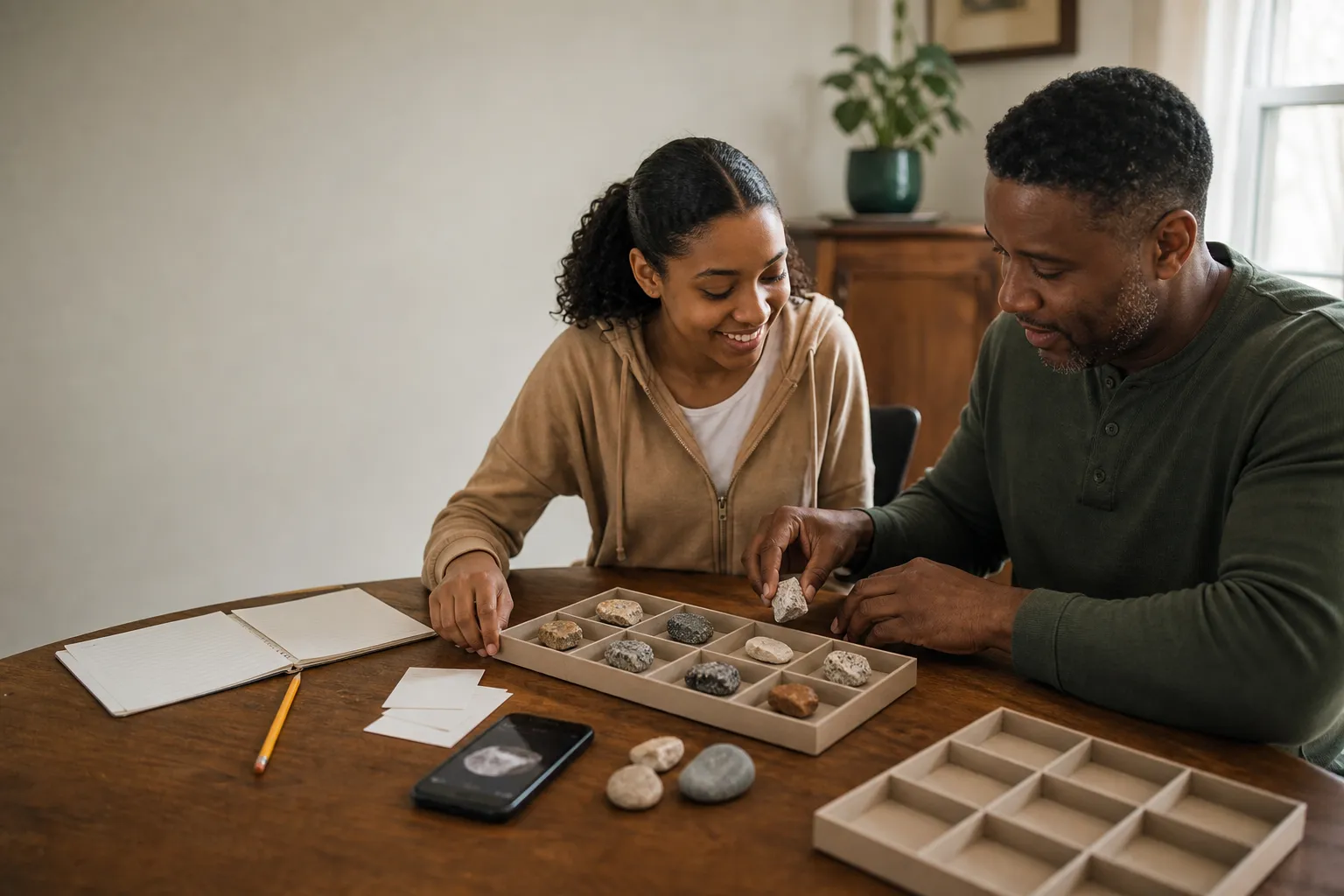
A good rock collection is not the largest pile you can fit on a shelf. It is a set of specimens that helps you notice, compare, remember, and ask better questions.
That distinction saves money and space. A dozen well-chosen, well-labeled rocks can teach more than a hundred mystery stones bought in one afternoon. The label preserves where a specimen came from. The gap between two examples invites comparison. Even an empty compartment can be useful: it represents a question you have not answered yet.
Begin with a boundary, not a shopping list.
Choose one question for the collection
“Interesting rocks” is too broad to guide a decision. A starter collection becomes coherent when every specimen helps answer the same kind of question.
Possible themes include:
- common rocks from one beach, county, or watershed;
- one clear example each of igneous, sedimentary, and metamorphic texture;
- quartz and several materials commonly confused with it;
- rocks connected to family trips, with lawful find locations and dates;
- minerals that demonstrate different lusters, cleavage patterns, or crystal habits; or
- a small local reference set for comparing future finds.
Write the theme on the first page of your catalog. Then set a physical limit: one 12-compartment tray, one drawer, or one shelf. A new specimen should fill a real gap, improve on a poor example, or carry a story important enough to justify its space.
If two stones teach the same lesson, keep the one with better provenance, clearer features, or greater personal meaning. Restraint is not a failure to collect. It is collection design.
Build a reference set before a rarity set
Rare names are exciting, but familiar materials are better teachers. Depending on your theme and region, a first tray might include a coarse-grained granite, a fine-grained dark volcanic rock, sandstone, limestone, quartz, calcite, a feldspar-rich specimen, and a mica-rich rock.
You do not need to buy that exact list. Use what you can obtain legally, affordably, and with reliable information. A plain basalt with a recorded location is more useful than a bright “mystery crystal” with no locality or trustworthy label.
Choose specimens that show the feature you want to study. A weathered pebble may be perfect for a beach-rock collection but poor for seeing fresh grain texture. A glittery object may be visually appealing yet add little if five stones already demonstrate the same luster.
Our guide to six clues beyond color can help turn a tray into a set of deliberate comparisons rather than a color assortment.
Use four acquisition lanes
There are more ways to build a collection than repeatedly buying retail specimens.
1. Lawful field finds
Collect only after identifying who manages the land and checking the current rules for the exact site and material. A nearby place that looks public may be private property, an active claim, a protected park, tribal land, a scientific site, a landscaped area, or a location with seasonal restrictions.
Rules differ sharply. The National Park Service says recreational collection of rocks and minerals is generally prohibited in National Park System units, with limited exceptions. The Bureau of Land Management generally permits reasonable amounts of common rocks, mineral specimens, and semiprecious gemstones for personal, noncommercial use on many BLM-managed lands, but restrictions apply at developed sites, active mining claims, areas with private mineral rights, and locally closed or specially managed land.
Do not transfer a rule from one agency, park, beach, or state to another. Check the land manager’s current page, posted signs, and local office before collecting. On private land, obtain the owner’s permission. Take modest amounts, avoid disturbing habitat or cultural features, and leave a notable specimen in place when removal would diminish the site for everyone else.
2. Gifts and inherited specimens
Ask the giver what they know before the story disappears. Record the original label exactly, who owned the specimen, an approximate acquisition date, and any stated locality. Keep uncertainty visible: “Family label says fluorite; locality unknown” is honest and useful.
Never discard an old label just because the name looks outdated. The paper may preserve provenance that cannot be reconstructed.
3. Club swaps and educational extras
Local gem and mineral clubs, geology departments, and experienced collectors sometimes offer common teaching specimens, swaps, or beginner events. Ask about the material, locality, and how it was acquired. A friendly source is still not a substitute for documentation.
4. Focused purchases
Buy to fill a named gap. Before a show or shop visit, write the material, maximum size, purpose, and budget. Then stop when the question is answered.
Ask a seller for the exact material name, locality, natural or synthetic status, known treatments, repairs, coatings, and whether the label belongs to that specific specimen. Treat extravagant origin, rarity, value, and healing claims as claims requiring evidence. A reputable answer may include uncertainty.
Give every specimen a number and a story
The U.S. Geological Survey has long emphasized permanent labeling because specimens become mixed and locations are forgotten. The essential habit is simple: assign a unique number and connect the physical specimen to a catalog entry.
For each new item, record:
- a unique catalog number;
- your current name or careful description;
- whether that identity is confirmed, probable, or unknown;
- exact locality at an appropriate level of privacy;
- collection or acquisition date;
- collector, giver, seller, or other source;
- legal or permission notes when relevant;
- size, visible features, and condition;
- the original seller or inherited label, quoted rather than silently rewritten; and
- a clear photograph that includes the correct specimen number.
Do this before the rock joins the tray. “I will remember which beach it came from” is how scientifically useful context becomes a box of attractive unknowns.
For a field find, place one specimen and its temporary field label in a separate bag. Do not rely only on a note written on the outside; abrasion and handling can erase it. At home, transfer the information into your catalog and keep a small label with the specimen.
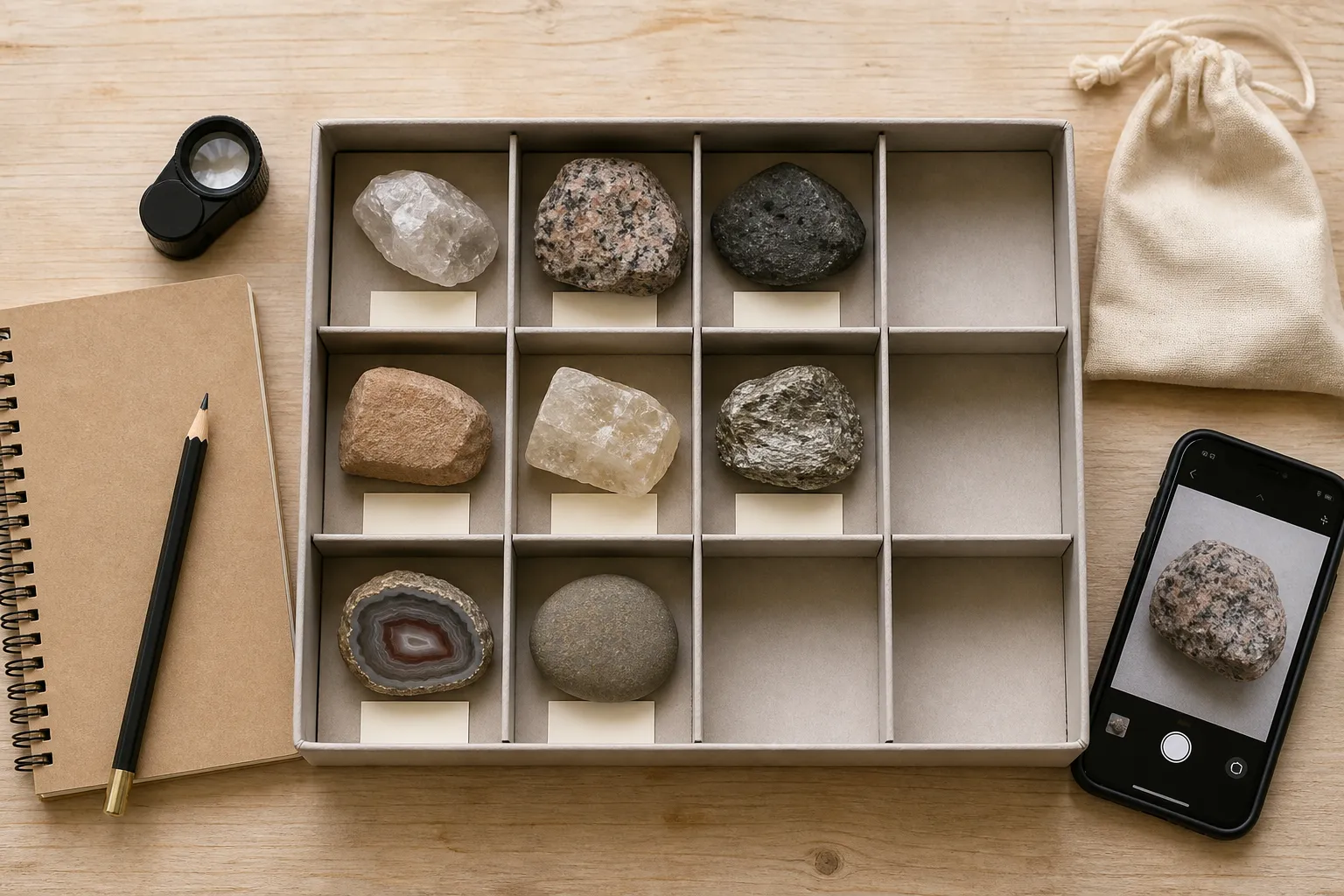
A limit creates room to compare. Every occupied space should have a specimen number and a catalog record; empty spaces are future questions, not shopping emergencies.
Store for the weakest specimen, not the toughest
Most ordinary rocks tolerate dry indoor storage, but a mixed collection can include fragile crystals, light-sensitive minerals, soluble materials, heavy pieces, or hazardous specimens.
- Give small specimens individual trays or boxes so they do not strike one another.
- Support fragile crystals from below and handle them as little as practical.
- Store heavy pieces on a low, stable shelf and do not overload drawers.
- Keep labels dry, legible, and physically associated with the correct specimen.
- Protect unknown dusty, fibrous, crumbly, or mine-associated material from handling and seek expert advice.
- Do not wash every acquisition by default. Water, detergents, brushes, and cleaning chemicals can dissolve, stain, loosen, or remove important material.
The National Park Service’s geological-collection guidance notes that some minerals need dark, dry, or specialized storage and that cleaning can cause irreversible loss. Museum standards can exceed what a home collection needs, but the principle scales down: learn what the specimen is before deciding how to clean or display it.
Do not cut, grind, polish, acid-test, lick, taste, or deliberately break an unknown specimen. If identification affects safe handling, value, or a scientific claim, preserve the object and seek an appropriate expert.
Photograph the collection as evidence, not decoration
A catalog photo should help you match the record to the object and recognize change over time. Start with one dry, color-accurate overview on a plain background. Add a scale in the same plane, then photograph the feature that earns the specimen its place: grains, banding, crystal faces, cleavage, or existing weathered surfaces.
Keep the catalog number with the photo session so images do not drift between records. Avoid filters and dramatic colored lighting. Our guide to taking better rock-identification photos provides a repeatable sequence.
A location photo can also preserve geologic context, but share precise coordinates thoughtfully. Sensitive fossil, cultural, private-property, and vulnerable collecting sites should not be advertised casually.
Create a waiting period for purchases
Collecting markets are designed to make every table feel like a once-only opportunity. A short rule can interrupt that pressure:
- Photograph or write down the candidate and its label, with the seller’s permission.
- State which gap it fills.
- Compare it with what you already own.
- Check the total cost, including a safe box or stand.
- Wait a day for ordinary online purchases, or walk the full show before returning.
Wishlist is a valid collection status. Wanting to learn about a specimen does not require owning it.
StoneScout’s encyclopedia lets you add an entry to a Wishlist or as an owned specimen. In My Collection, you can add photos and field notes. Use those tools to compare candidates and record your current thinking, including uncertainty. Keep irreplaceable provenance in a second form as well—such as a paper label plus an independent catalog copy—rather than trusting any single phone, app, or notebook as the only record.
Review the collection, do not merely expand it
Every few months, place the whole collection where you can see it and ask:
- Does each specimen still fit the theme?
- Can each number be matched to a catalog record?
- Which identities are tentative?
- Is any specimen deteriorating or stored unsafely?
- Which duplicates could become a gift, swap, or teaching sample?
- What one comparison would teach the most next?
Do not sell, trade, or give away material if its collection was restricted to personal, noncommercial use or if its legal provenance is uncertain. Keep inherited and original labels with any lawful transfer.
The aim is not to finish geology. It is to build a small set that makes you look more closely. When every specimen has a reason, a record, and room around it, the collection grows in knowledge faster than it grows in volume.
Sources
- Collecting Rocks — U.S. Geological Survey
- Guide to Planning for and Managing Scientific Working Collections — U.S. Geological Survey
- Start a Rock Collection — American Museum of Natural History
- Rockhounding on Public Lands — Bureau of Land Management
- Geology Permits and Recreational Collecting — National Park Service
- Curatorial Care of Paleontological and Geological Collections — National Park Service
- Museum Property Handbooks — U.S. Department of the Interior