
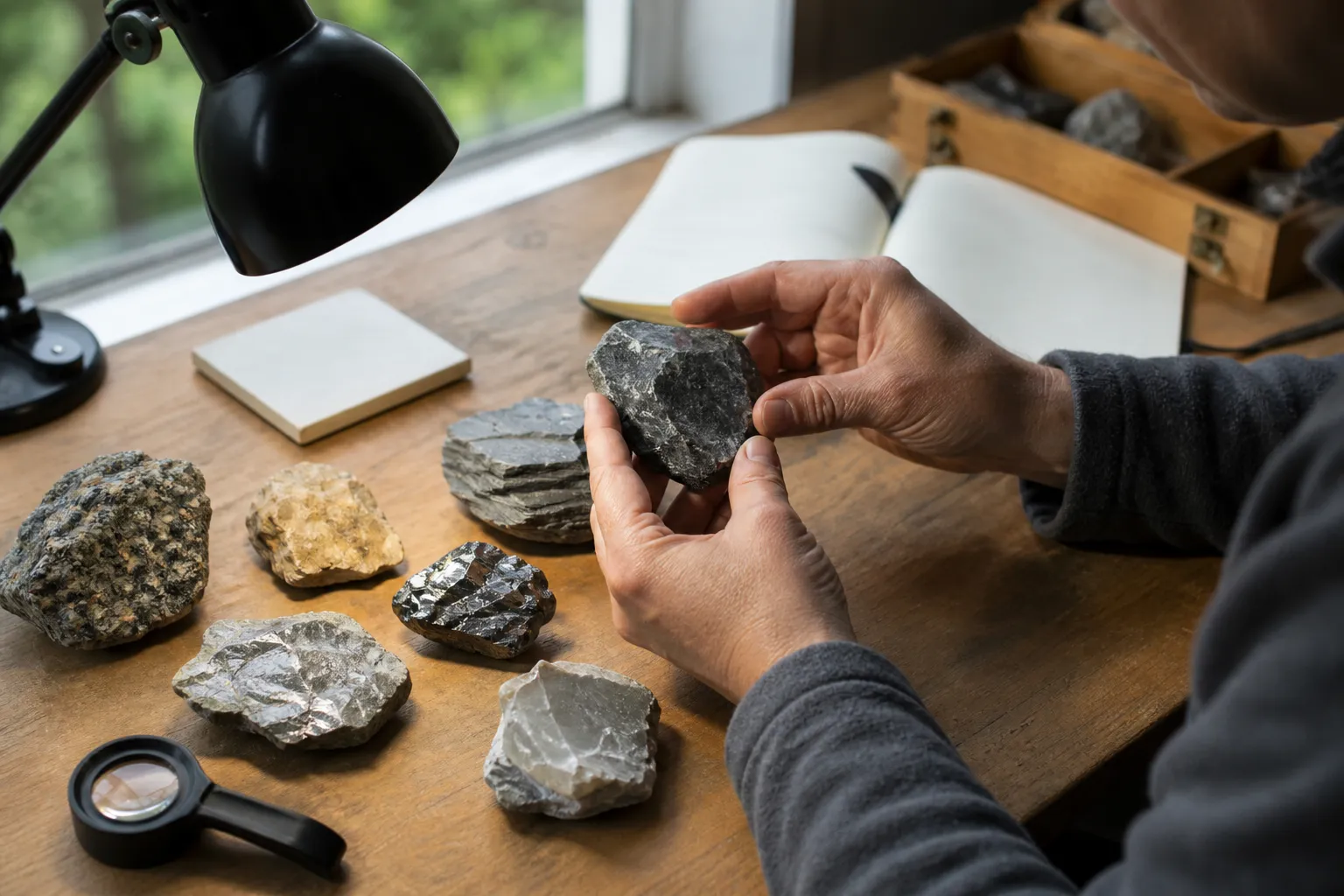
Color is the first thing most of us notice about a stone—and one of the easiest clues to overvalue.
Quartz can be colorless, purple, pink, gray, or yellow. Different green minerals can look nearly identical in a phone photo. Rust-colored staining can coat a material whose fresh surface is nothing like its exterior. The U.S. Geological Survey explicitly cautions that color is unreliable for most mineral identification because one mineral can have multiple colors and several minerals can share the same color.
Color still belongs in your notes. It just should not carry the whole identification. These six clues usually ask better questions.
1. Luster: how the surface handles light
Luster is not the same as color or transparency. It describes the quality of reflected light from a surface. Begin with the broadest split: does the specimen reflect light like a piece of metal, or not?
Nonmetallic luster can then be described as glassy, pearly, waxy, earthy, silky, greasy-looking, or dull. Use a small lamp or diffuse daylight and gently turn the specimen. Compare several surfaces: a weathered exterior may be dull while an existing chip or crystal face looks glassy.
Do not confuse scattered sparkles with a metallic luster. Tiny mica flakes can flash strongly inside an otherwise nonmetallic rock. Describe what proportion of the specimen reflects and whether the reflection is continuous, flaky, or limited to grains.
2. Grain size and texture: what the material is built from
Ask whether you can see individual grains with your unaided eye or a hand lens. Are they interlocking, rounded, layered, aligned, or suspended in a finer background? Are they all about the same size? Do you see holes, bands, pebbles cemented together, glassy patches, or a smooth mass with no visible grains?
Texture often tells you whether you are dealing with a multi-mineral rock or a more uniform mineral specimen. The USGS describes most rocks as mixtures of minerals; granite commonly shows quartz, feldspar, mica, and other grains together. Texture can therefore support a rock-family description even when an exact mineral list is not possible from a photo.
Use a ruler in close-up images. “Fine grained” and “coarse grained” become more useful when another person can see the actual scale.
3. Crystal form: repeated geometry, not just pointiness
Minerals grow according to internal structures that can produce characteristic external forms, often called crystal habits. Look for repeated prisms, cubes, plates, needles, fibers, blades, or radiating groups. The repetition matters more than one accidental corner.
Weathering and crowding can hide an ideal form. A mineral may occur as a massive lump with no obvious crystal faces, while the same species forms clear crystals elsewhere. Crystal form is therefore supporting evidence, not a requirement.
Be especially cautious with “crystal” as a marketplace label. A polished point, carved tower, or broken shard may have a manufactured outline unrelated to the material’s natural growth.
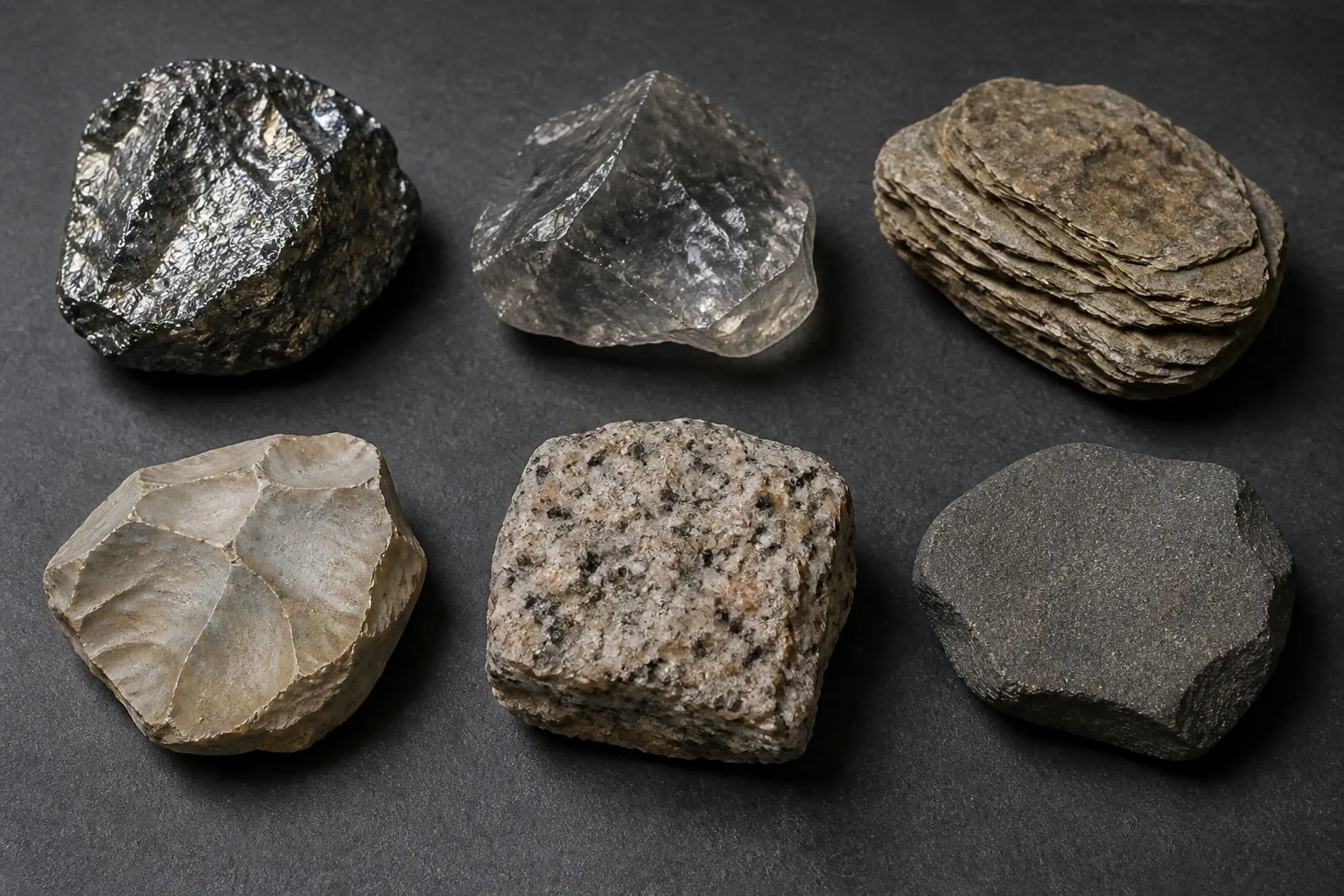
One restrained color palette can still contain many different physical clues.
4. Cleavage and fracture: how existing surfaces relate
Cleavage is a mineral’s tendency to split along weak planes in its internal structure. It can produce repeated flat surfaces that meet at characteristic angles. Fracture describes breakage that does not follow cleavage; one familiar type is conchoidal fracture, with curved shell-like surfaces.
Study surfaces that already exist. Do not strike or snap a specimen to expose a new one. One flat face is not enough to establish cleavage: it could be a crystal face, a cut or polished surface, a joint in a rock, or simple chance. Look for several parallel planes or a repeated angle.
Rocks made of many small grains may break around or through those grains rather than display the clean cleavage of one mineral. Record exactly what you see instead of forcing the specimen into a tidy diagram.
5. Relative hardness: what scratches what
Hardness is resistance to scratching, not resistance to breaking. A brittle mineral can be hard, and a tough material can be relatively soft. The Mohs scale orders reference minerals from talc at 1 to diamond at 10, but the intervals are not equal units.
Hardness is powerful because it can separate lookalikes that share color and luster. It is also easy to test badly. A softer metal object may leave a gray streak on a harder mineral and appear to have scratched it. Weathered coatings can be softer than the material beneath them. Testing can permanently mark polished, delicate, valuable, or scientifically important specimens.
For a first pass, record existing evidence: Does a corner already show wear? Are softer grains recessed while harder grains stand proud? If a formal relative-hardness test is truly needed, use a dedicated procedure on a known-safe, common, expendable specimen. Do not scratch an unknown fibrous, powdery, encrusted, valuable, or culturally important object.
6. Heft: how heavy it feels for its size
Specific gravity compares a material’s density with the density of water. You do not get that number merely by holding a rock, but comparing the heft of similarly sized specimens can reveal that one is unexpectedly heavy or light.
Heft is especially useful when paired with other clues. A dark metallic-looking specimen that feels unusually heavy belongs on a different shortlist from a bubbly, glassy-looking fragment that feels light for its size. Hollow geodes, porous volcanic rocks, dense ore minerals, and metal-rich slag can all depart from what appearance alone suggests.
Compare only objects of roughly similar volume, and support heavy specimens over a table. A precise specific-gravity measurement requires a controlled method and may be inappropriate for porous, water-sensitive, mounted, or valuable material.
Combine clues as a pattern
No single observation deserves automatic authority. A useful field description combines them:
Palm-sized, brassy metallic specimen; blocky repeated faces; dark areas between reflective grains; feels heavy for its size; no visible layers.
That description is more discriminating than “gold rock,” but it still does not prove gold, pyrite, chalcopyrite, or a manufactured material. Our pyrite-versus-gold comparison shows how to carry that shortlist forward without damaging the specimen. Each candidate must explain the same set of observations.
This is also how StoneScout’s candidate-and-confidence approach is most useful. Start with the ranked visual possibilities, then compare alternatives against the luster, texture, form, existing breakage, apparent hardness clues, and heft you can observe safely. If a new clue contradicts the top match, the ranking should change—not the observation.
Optional clues and safe limits
Magnet response and streak can be valuable in the right setting, but each needs careful interpretation. A magnet may respond to only a few grains within a rock. A streak plate can damage a specimen, fail on minerals harder than the plate, or create hazardous powder from an unsafe material. Save those checks for dedicated guidance.
Never use acid, flame, taste, licking, grinding, or deliberate breakage to settle an identification. Do not brush or handle an unknown fibrous or dusty specimen. Cutting and grinding stone can release respirable crystalline silica; some naturally occurring fibrous minerals may present additional hazards. When safety, value, legality, or authenticity matters, stop at the shortlist and consult a qualified expert.
Sources
- Minerals and their physical properties — National Park Service
- USGS mineral and rock education resources
- Natural mineral gemstones and identifying characteristics — U.S. Geological Survey
- How gemologists combine visual and physical clues — Gemological Institute of America
- Safe work practices for crystalline silica — CDC/NIOSH