
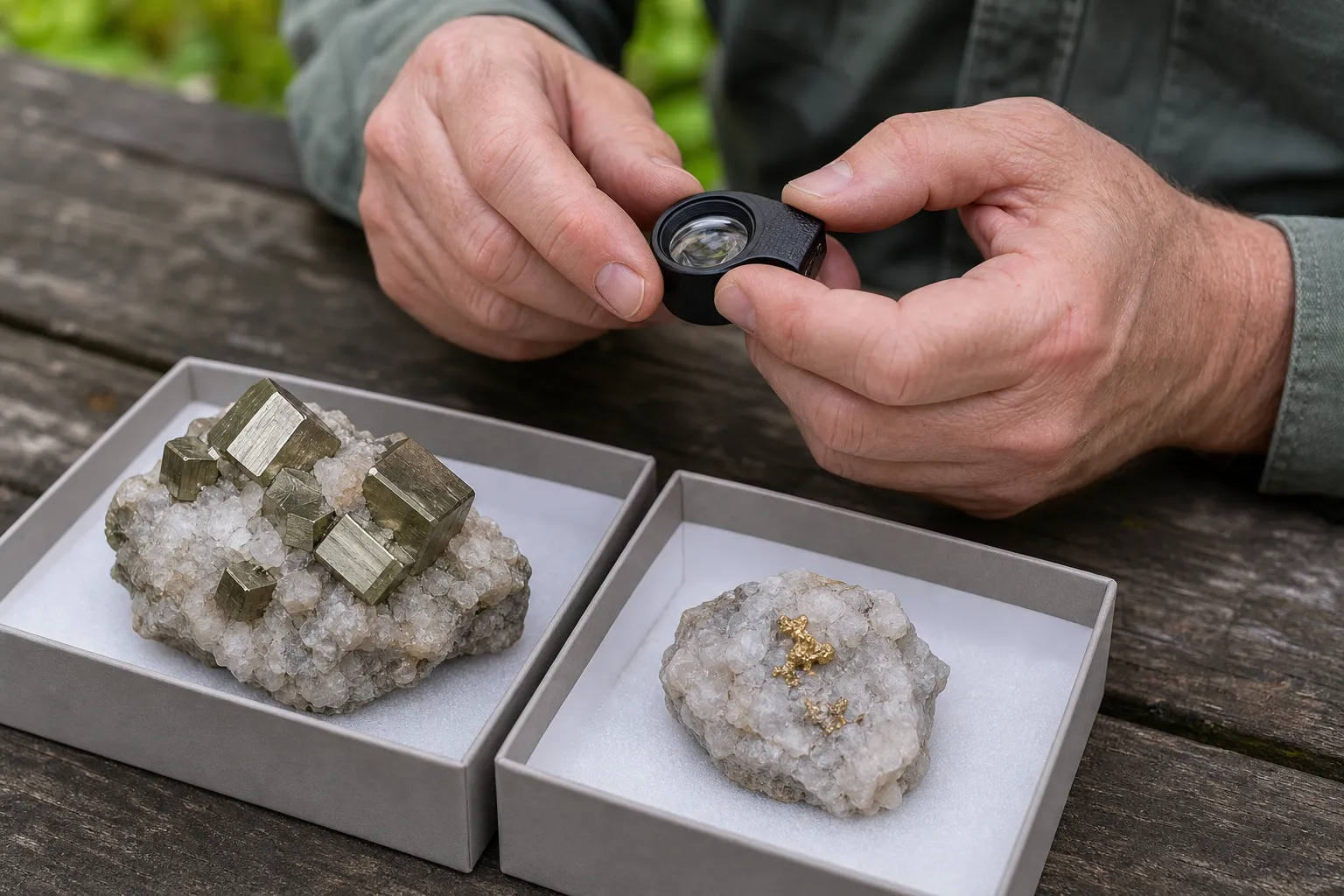
A brassy glint in quartz can start a gold-rush feeling in seconds. The reflective grains may be pyrite, native gold, chalcopyrite, weathered mica, or even a manufactured fragment—and a phone photograph can make their colors look more alike than they do in hand.
The goal is not to prove “gold” at the kitchen table. It is to build a careful shortlist while keeping the specimen intact. Shape, surface, color, heft, and context can move one candidate ahead of another without scratching, crushing, streaking, or prying at the bright material.
Begin with the material, not the nickname
Pyrite is iron sulfide, FeS₂. It is a common opaque mineral with metallic luster and a pale brassy-yellow color. The University of Minnesota lists a Mohs hardness of 6 to 6.5, specific gravity around 5 or greater, and a brittle character. Pyrite often forms cubes or octahedrons, sometimes with fine parallel lines called striations on its flat faces.
Native gold is the element Au occurring as a metal, commonly mixed naturally with some silver or other metals. Geoscience Australia lists pure gold at Mohs 2.5 to 3 and a relative density of 19.3. It is soft, highly malleable, and ductile rather than brittle.
Those property differences are real, but proving them can damage a specimen. Use them first to interpret features that already exist. A sharp cube with repeated flat faces supports pyrite. A rounded, flattened, bent, or wire-like metallic particle is more compatible with gold. Neither shape is a verdict by itself.
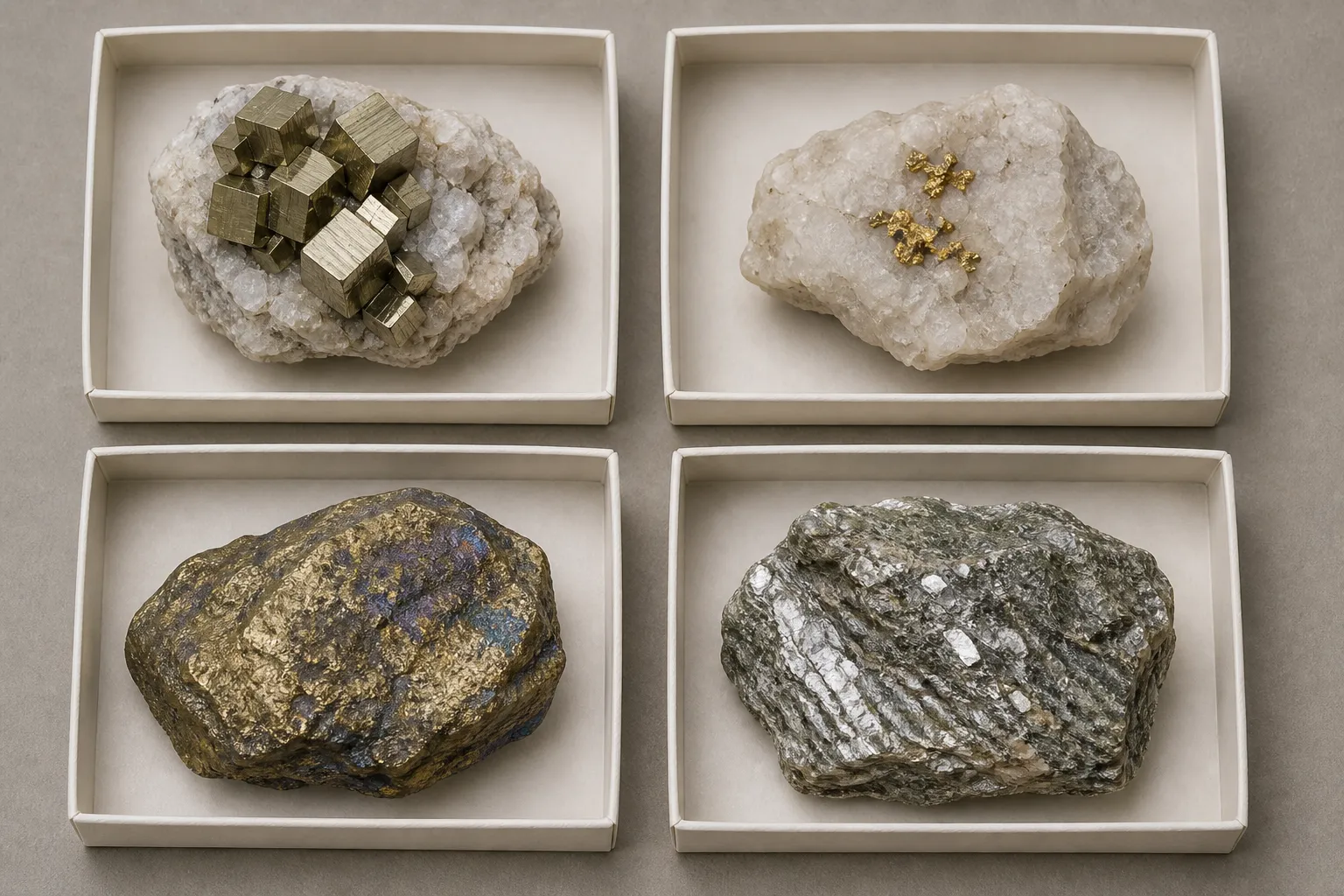
Known reference specimens make differences easier to learn. An unknown find still needs several matching clues.
Six non-destructive comparisons
1. Look for repeated geometry
Turn the specimen slowly under diffuse daylight and inspect the bright areas with a hand lens. Pyrite commonly presents crisp, flat faces: cubes, eight-faced forms, or intergrown blocky crystals. Fine parallel striations may cross some faces.
Visible native gold more often appears as irregular grains, flakes, rounded particles, branching wires, or thin masses filling cracks. Gold does have an ordered crystal structure, so “gold never forms crystals” is too absolute. The useful field clue is narrower: a group of sharp, repeated brassy cubes strongly favors pyrite over the usual visible forms of native gold.
Do not chip away surrounding quartz to expose a hidden shape. The relationship between a metallic grain and its host rock is part of the specimen’s evidence.
2. Compare color across light, not from one photograph
Both materials have metallic luster, but pyrite is commonly pale brass-yellow while native gold has a richer yellow tone. Tarnish, iron staining, reflected sky, warm indoor bulbs, and a phone’s automatic white balance can erase that distinction.
Move one dry surface through neutral light. Ask whether the color remains consistent or appears only as momentary flashes from separate flat faces. Record “pale brassy metallic cubes” or “warm yellow irregular flake” instead of upgrading a color impression into a name.
Our guide to mineral luster explains why metallic reflection and yellow color are separate observations. A wet surface is not better evidence; water can deepen color and change the apparent shine.
3. Study existing edges for brittle or bent behavior
Pyrite is brittle. Existing damaged areas may be angular, chipped, granular, or crumbly. Gold is malleable, so an existing edge may look flattened, folded, smeared, or bent instead of shattered.
The U.S. Geological Survey contrasts minerals that flake, powder, or crumble under a point with gold, which indents. That is a useful laboratory or reference-specimen distinction—not an invitation to poke an unknown find. Do not press it with a knife, hammer it flat, or pull a grain from its matrix. Look only at wear and deformation that were already present.
4. Treat heft as supporting evidence
Gold is exceptionally dense: pure gold has a relative density of 19.3, compared with roughly 5 for pyrite. A similarly sized solid piece of gold would therefore feel dramatically heavier.
Most real finds do not offer that tidy comparison. A tiny metallic fleck contributes almost nothing to the heft of a palm-sized quartz rock, porous material can feel unexpectedly light, and a dense manufactured alloy can feel heavy. Heft can challenge a guess, but a hand-held impression cannot establish composition or gold content.
5. Keep the host rock and find context in view
Pyrite occurs in many igneous, metamorphic, sedimentary, and hydrothermal settings. It is common in quartz and calcite veins and can occur alongside chalcopyrite and gold. Association therefore cuts both ways: pyrite in a quartz vein does not prove the quartz contains economically meaningful gold, and a rusty weathered surface does not prove a valuable deposit.
Context can still improve the question. Record whether the bright material occurs as loose stream grains, cubes scattered through a rock, a vein filling, a weathered coating, landscaping material, or industrial fill. Make a context photograph before moving anything, and check ownership, active mining claims, and site-specific collecting rules. Rules differ among federal, state, local, tribal, and private land; a general guide is not permission to collect.
6. Ask whether the photograph can carry the conclusion
A close photo can show geometry, grain relationships, tarnish, and existing damage. It cannot measure density, hardness, streak, malleability, or gold concentration. Sparkle is especially easy to exaggerate when the camera clips highlights against a dark rock.
StoneScout can use the selected photograph and physical details you enter to rank visual candidates. For a brassy find, compare pyrite, gold, chalcopyrite, mica, and manufactured material rather than accepting the first familiar label. The field guide can organize expected properties, but the result remains a starting point—not a certification, assay, or appraisal.
Keep chalcopyrite and mica on the shortlist
Pyrite is not the only “fool’s gold.” USGS also names chalcopyrite and weathered mica as common sources of confusion.
Chalcopyrite is another brassy metallic sulfide. It is generally softer than pyrite, less likely to show sharp cubic crystals, and may tarnish to purple, blue, or other iridescent colors. Tarnish is variable, so its absence does not rule chalcopyrite out.
Mica can flash gold or bronze when thin sheets catch the light. Look for platy flakes, sheet-like cleavage, and reflections that switch on and off across separate grains. A mica-rich rock can sparkle strongly while the rock as a whole remains nonmetallic.
Rounded slag, metal fragments, glitter, and other manufactured material also belong on the list when the find came from fill, a rail bed, a former industrial site, or an urban shoreline. Six clues beyond color gives a reusable way to compare all of these candidates as one evidence pattern.
Why streak and scratch are not the first move
Reference books often separate gold and pyrite by hardness or streak. Gold leaves a yellow streak; pyrite and chalcopyrite leave dark green to black streaks. But a streak test abrades the material, and a scratch comparison can permanently mark it. An unknown metallic coating or mine-waste specimen may also be unsafe to powder.
For a common, solid, known-safe, expendable teaching specimen, follow a controlled streak-plate procedure. For an unknown, valuable-looking, crumbly, encrusted, or historically important object, stop at observation. Never grind, sand, crush, drill, burn, taste, or apply acid to force an answer. Cutting and crushing mineral-bearing rock can release respirable silica and other mineral dust.
When the answer matters
Visible gold color does not establish how much gold a rock contains, whether the material is native gold, or what a specimen is worth. USGS notes that gold may be present even when it is not visible and that determining gold content can require representative sampling and laboratory analysis. A photograph cannot substitute for that work.
If the distinction affects a purchase, sale, insurance decision, mining claim, scientific record, or safety question, preserve the specimen and its provenance. Ask a geologist or appropriate laboratory what examination is suitable and whether sampling would be required. Do not use a visual result as an appraisal or as evidence that a site is commercially promising.
The strongest field conclusion may be modest: “brassy cubic sulfide, pyrite likely,” or “warm yellow irregular metal; gold remains possible and needs expert confirmation.” That is not a disappointing answer. It is an intact specimen, a better question, and a shortlist grounded in observations rather than sparkle.
Sources
- What is “Fool’s Gold?” — U.S. Geological Survey
- Pyrite — University of Minnesota Common Minerals
- Gold — Geoscience Australia
- Minerals and their physical properties — National Park Service
- Prospecting for Gold in the United States — U.S. Geological Survey
- Can I Keep This? — Bureau of Land Management
- Safe work practices for crystalline silica — CDC/NIOSH