
Names become useful when they explain the specimen in front of you. Start with the relationships among rocks, minerals, and crystals, then use focused comparisons to see why color or sparkle alone can send an identification in the wrong direction.
Field guide topic
Rocks, Minerals, and Crystals: A Practical Guide
Understand how familiar rocks, minerals, and crystals relate, then compare common lookalikes without forcing a verdict.
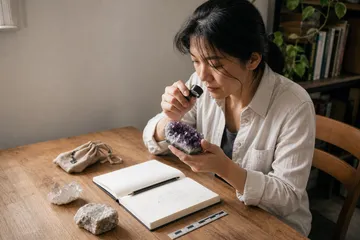 Crystal Meanings, Tradition, and What Science Can Actually SaySeparate crystal lore and personal symbolism from measurable mineral properties, clinical evidence, and the health claims science can actually test.
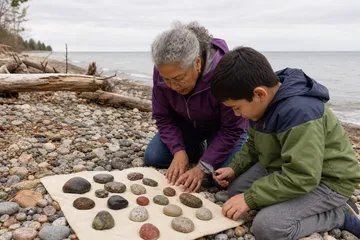 Common Stones of Great Lakes BeachesLearn the rock groups commonly seen on Great Lakes shores, how glaciers mixed them, and how to observe them without overclaiming or collecting illegally.
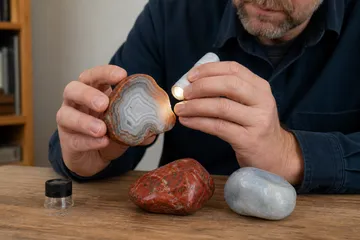 Agate, Jasper, and Chalcedony: How They RelateSee how chalcedony, agate, and jasper overlap, which visible clues separate them, and why some specimens sit honestly between the names.
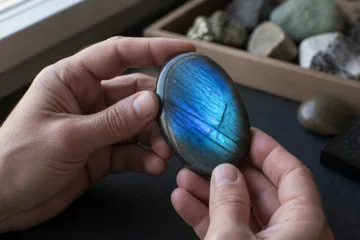 What Causes Labradorite’s Blue Flash?Learn how microscopic feldspar layers create labradorite’s directional blue flash, why it vanishes at some angles, and what the effect can—and cannot—identify.
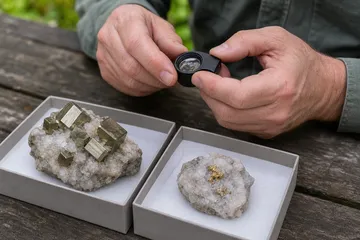 Pyrite vs. Gold: Clues You Can Check Without Damaging the SpecimenCompare pyrite, native gold, chalcopyrite, and mica using form, color, heft, and existing surfaces—without scratching or crushing your find.
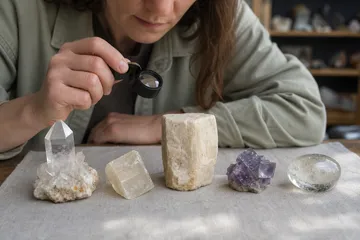 Quartz and Its Common LookalikesCompare quartz with calcite, feldspar, fluorite, and glass using crystal shape, cleavage, fracture, hardness, and other non-destructive clues.
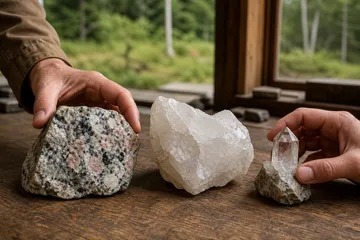 Rock vs. Mineral vs. Crystal: What’s the Difference?Learn how rocks, minerals, and crystals relate, why one specimen can fit more than one term, and which visible clues help you describe a find.