
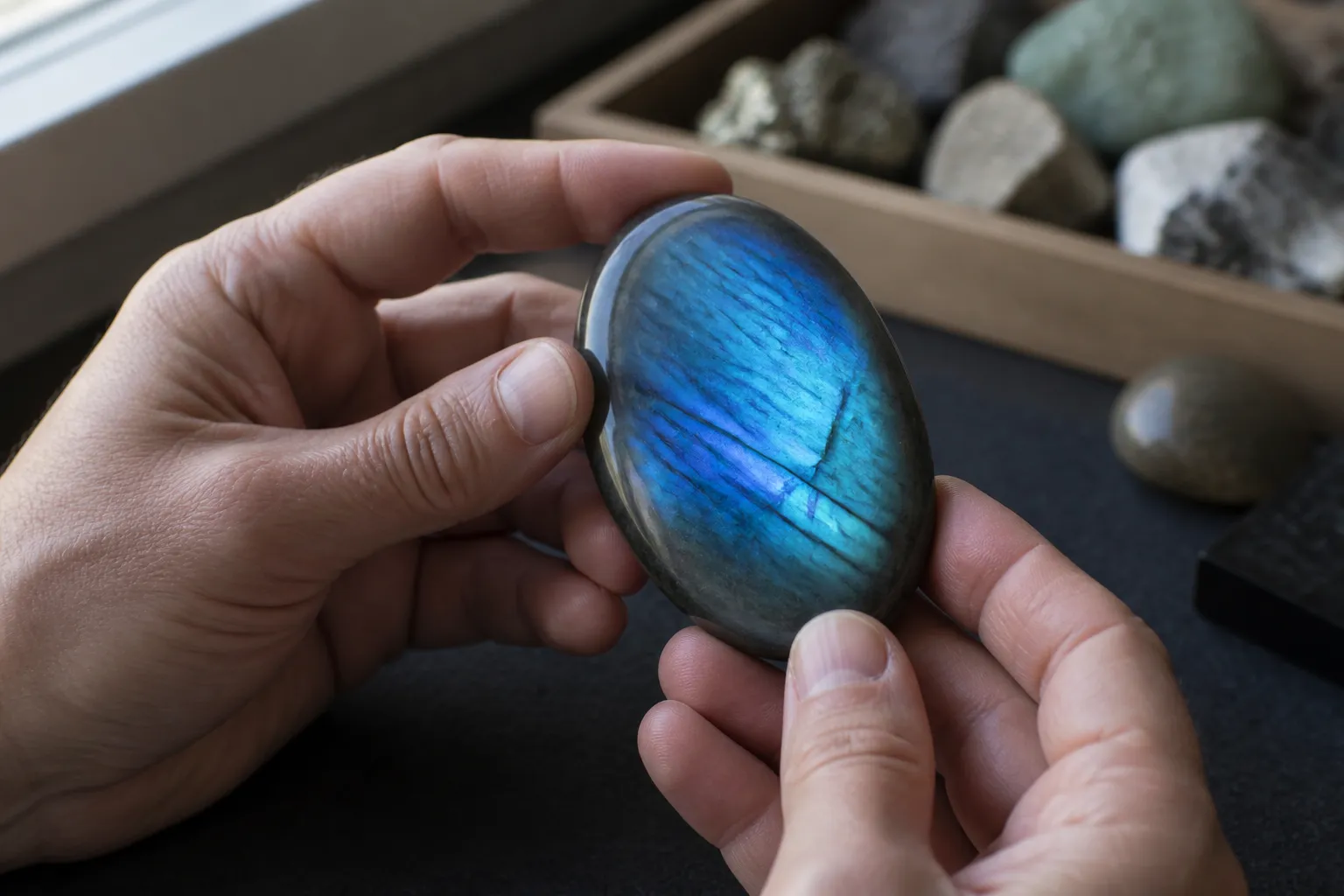
Turn a gray labradorite stone in the light and a sheet of blue may suddenly appear, then vanish after another few degrees. The color can look as though it is painted on the surface or glowing from inside. It is neither. The flash is a directional optical effect created when light meets extremely thin, regularly spaced structures within the feldspar.
That effect is called labradorescence once the material has been identified as labradorite. It explains why one photograph can look electric blue while another photograph of the same stone looks almost charcoal gray.
Labradorite is a plagioclase feldspar
Feldspar is a large mineral family, and plagioclase is a continuous compositional series between sodium-rich albite and calcium-rich anorthite. Labradorite occupies a middle, calcium-bearing portion of that series. A typical specimen is gray, brownish, greenish, nearly colorless, or dark when the flash is not visible.
Like other plagioclase feldspars, labradorite is around Mohs 6–6.5 and has two prominent cleavage directions meeting near a right angle. Fine parallel striations may appear on some cleavage surfaces because of crystal twinning. These properties help place an unknown in the feldspar family, but a polished cabochon may conceal most of them.
The vivid blue is not the stone’s ordinary bodycolor. It is light returned from an oriented internal structure.
Cooling builds layers too small to see
At high temperature, calcium-rich and sodium-rich feldspar components can share one crystal structure more evenly. As suitable labradorite cools very slowly, that structure can separate at a microscopic scale into alternating layers with slightly different compositions. Mineralogists call this solid-state separation exsolution and the thin layers lamellae.
In iridescent labradorite, this especially regular structure is known as a Bøggild intergrowth. The layers are measured in nanometers—far thinner than a human hair and too small to resolve with a hand lens.
When white light enters the stone, portions reflect from successive internal boundaries. The reflected waves overlap. At a particular combination of layer spacing, lighting, and viewing angle, some wavelengths reinforce one another while others cancel or pass through. Smithsonian and Gemological Institute of America references describe the result as diffraction or interference from the alternating feldspar layers.
The flash is therefore structural color. It depends on physical spacing and refractive-index differences inside the mineral, not on blue pigment painted across the face.
Why blue is so common
The spacing of the alternating layers helps determine which wavelengths return most strongly. The GIA’s review of phenomenal gemstones reports that the regular paired layers responsible for blue labradorescence total roughly 150 nanometers in a typical blue-producing structure. Wider spacing can favor longer-wavelength greens, yellows, oranges, and reds.
Natural specimens are not uniform optical stacks. Layer thickness, composition, orientation, fractures, and neighboring zones vary across a crystal. One cabochon can therefore show a mostly blue field, sharp boundaries between colors, or several flashes that turn on at different angles.
“Rainbow labradorite” is a trade description for material showing a wider range of labradorescent colors; it does not define a separate mineral species. “Spectrolite” is a trade name associated with vividly multicolored Finnish labradorite. Neither term should replace observations of the actual stone.
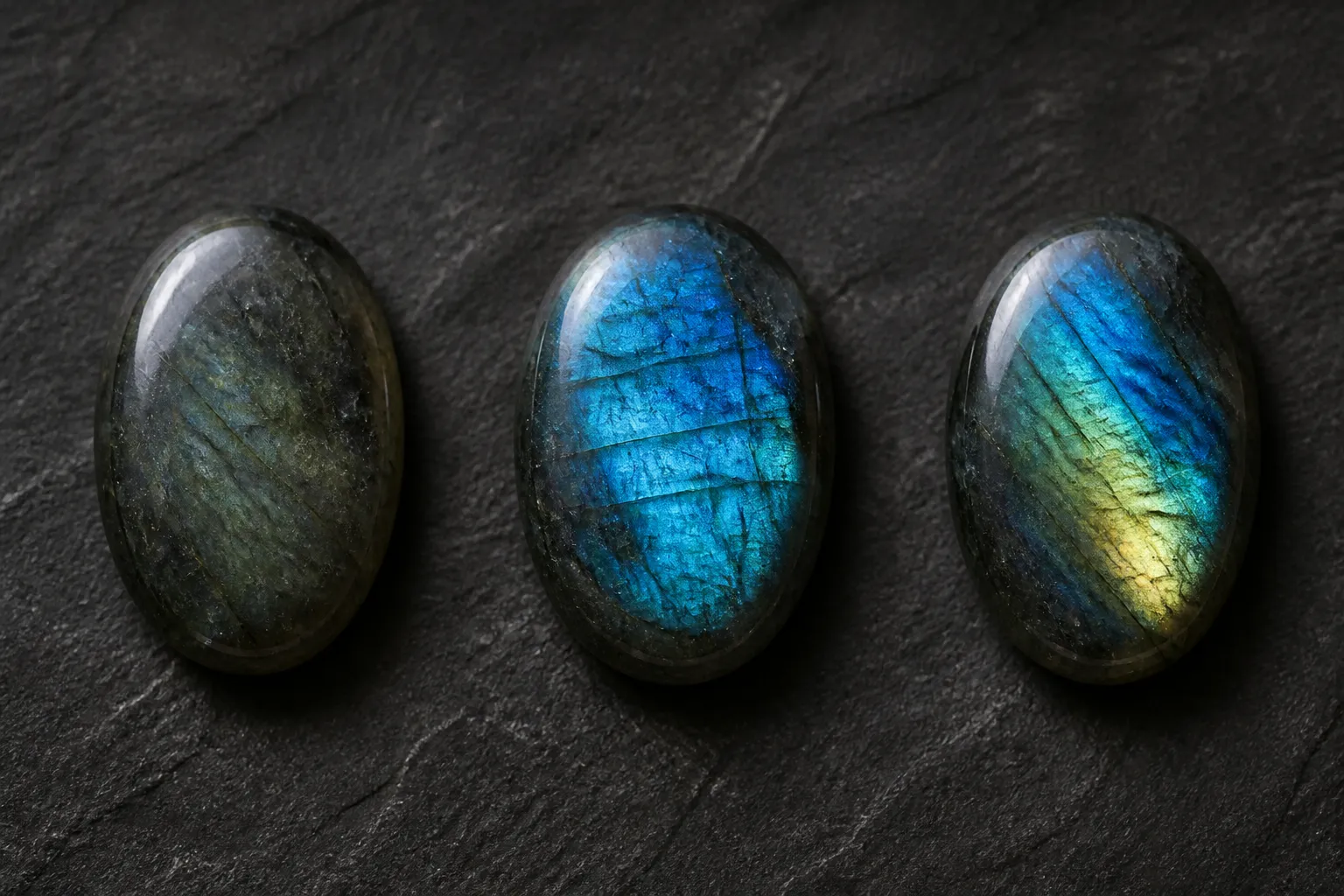
Labradorescence is directional. Similar stones—or one stone viewed in sequence—can move from subdued gray to intense color as their orientation changes.
Why the flash disappears when the stone turns
The internal layers have a preferred orientation. A bright reflection reaches your eye only when the light source, layers, and viewing direction line up within a useful range. Tilt the stone, move the lamp, or move your head, and that relationship changes. The blue may slide across the face, change color, or disappear.
A flat polished surface shows strong flash over a relatively narrow set of angles. A domed cabochon presents a range of surface orientations at once, so some part of the curve can return the effect across a wider viewing range. Cutters orient the stone to place a promising internal layer system beneath the display face; an unfortunate cut can leave vivid potential facing the side or back.
Rough labradorite may show little color because its surface is weathered, uneven, or poorly aligned with the internal layers. That does not justify grinding or breaking an unknown. Lapidary orientation removes material and calls for dust control, appropriate equipment, and experience.
Flash, luster, and bodycolor are different observations
These terms are easy to blend together:
- Bodycolor is the stone’s general color away from the optical effect—often gray or dark in familiar labradorite.
- Luster describes how the surface reflects light. Labradorite is commonly vitreous to pearly. Our mineral-luster guide explains how to observe that moving reflection.
- Labradorescence is the broad, oriented internal iridescence associated with identified labradorite.
Other gems produce different-looking phenomena. Moonstone’s adularescence is typically a softer, billowing light. Sunstone’s aventurescence comes from reflective inclusions and looks more glittery. Opal play-of-color usually breaks into shifting patches rather than the broad feldspar sheet seen in labradorite.
Those comparisons describe appearance, not a home certification method. The GIA recommends the general word iridescence for an unidentified feldspar because names such as labradorescence, adularescence, and peristerescence are tied to particular materials. A convincing blue flash supports a labradorite hypothesis, but it should not be used circularly: “It is labradorescence, therefore it must be labradorite.”
Observe the effect without damaging the stone
Use one steady white light against an uncluttered background. Hold the specimen securely over a padded surface and rotate it slowly through several directions. Move the stone first; keep the light and your eyes relatively still so the directional change is easier to understand.
Record four things:
- the bodycolor when no flash is visible;
- the colors that appear;
- whether the effect forms a broad sheet, scattered glitter, a floating glow, or small patches; and
- which face and angle produce the strongest response.
Then look for compatible feldspar traits already exposed: blocky form, near-right-angle cleavage, and fine parallel striations. Do not scratch a polished piece, jewelry, a valued specimen, or a promising rough. Hardness alone cannot distinguish every feldspar, and a new scratch may ruin the best optical face.
Why one photo is incomplete evidence
A still photo freezes one lighting and viewing geometry. It may capture maximum flash and hide the gray body, or miss the effect entirely. Camera exposure, white balance, saturation, and reflected sky color can make the blue look stronger or weaker than it did in person. A photograph also cannot verify hardness, cleavage hidden by polish, refractive index, or composition.
For documentation, take at least two frames without changing the camera’s color settings: one showing the bodycolor and overall shape, and one after tilting the stone into its strongest flash. A short video can record the transition for a collector or expert, but StoneScout analyzes one selected photo per scan. The specimen-photo guide shows how to keep focus, scale, and lighting honest.
StoneScout’s built-in field guide can help compare labradorite with other feldspars and phenomenal stones by physical properties and common lookalikes. Treat the result as a ranked starting point. A photograph of blue iridescence cannot certify natural origin, treatment history, locality, or value; those questions may require a gemologist and laboratory instruments.
Labradorite’s flash is most useful when it inspires a better description: gray plagioclase-like material, broad blue internal iridescence, visible only across a particular face and angle. That observation says far more than “a blue stone,” while still leaving room for the evidence a photo cannot supply.
Sources
- Labradorite carving — Smithsonian National Museum of Natural History
- Structures Behind the Spectacle: phenomenal gemstones and their nanotextures — Gems & Gemology
- Optical Effects of Phenomenal Cabochons — Gemological Institute of America
- Plagioclase feldspar — University of Minnesota Common Minerals