
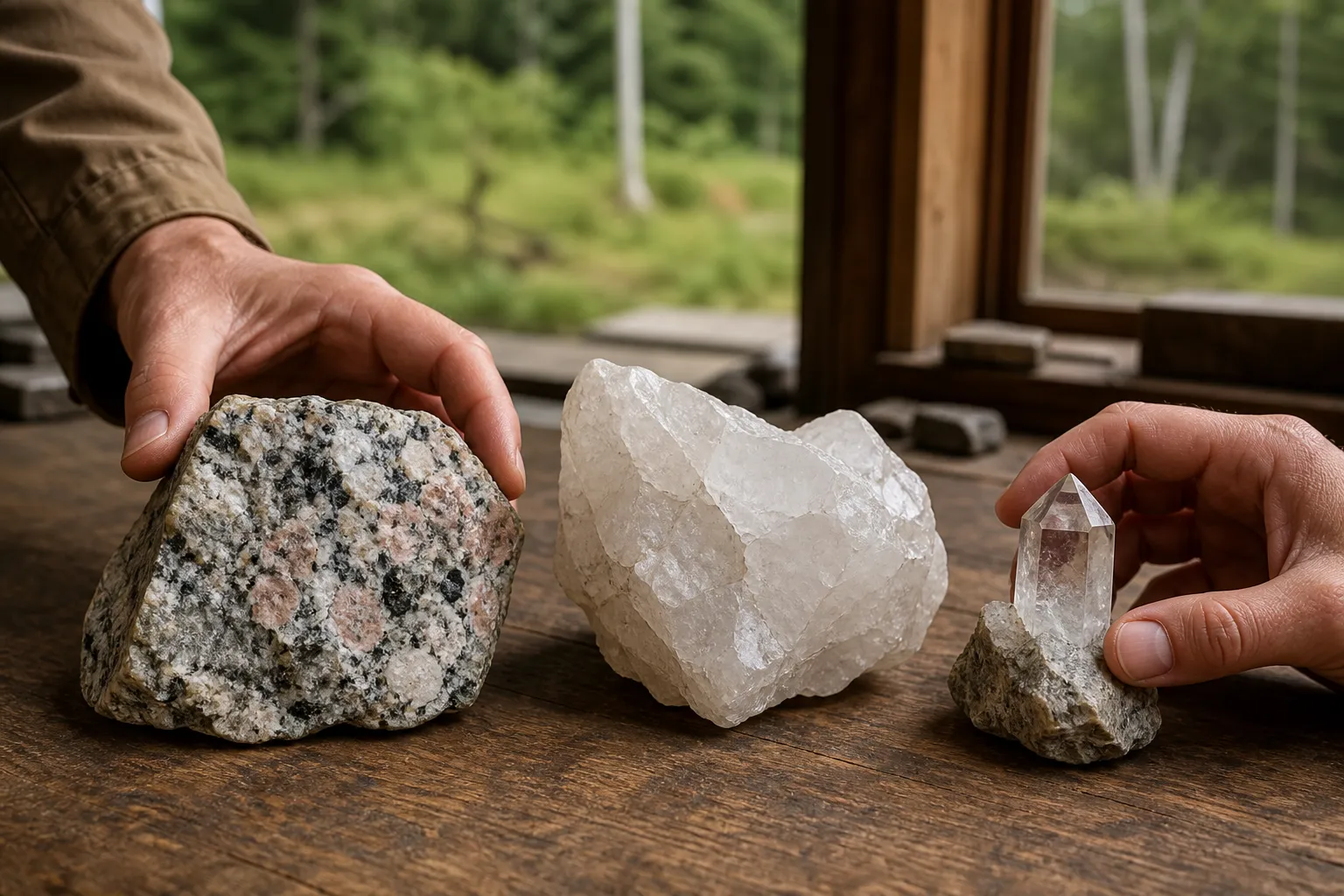
A striped beach pebble, a clear quartz point, and a piece of granite can all be called “stones” in everyday conversation. In geology, though, rock, mineral, and crystal answer different questions.
A mineral is a particular natural material. A rock is a naturally occurring body made from one or more materials, commonly minerals. A crystal is a solid with an orderly internal arrangement—and, in casual collecting language, often a specimen whose geometric growth shape is visible.
Those categories overlap. A quartz point can be both a mineral specimen and a crystal. Quartz grains inside granite are minerals and crystalline, while the whole granite specimen is a rock. The useful question is not always “Which single box does this fit?” but “What level of the specimen am I describing?”
A mineral has a characteristic composition and structure
The U.S. Geological Survey defines a mineral as a naturally occurring inorganic element or compound with an orderly internal structure and characteristic chemical composition, crystal form, and physical properties.
Quartz is a mineral made of silicon and oxygen, expressed as SiO₂. Calcite is a different mineral, calcium carbonate, or CaCO₃. A mineral’s composition may allow some natural variation, but its structure and properties remain characteristic enough to distinguish it from other minerals.
That is why color alone cannot define a mineral. Quartz may be colorless, milky, purple as amethyst, pink as rose quartz, or smoky gray. Its identity rests on a pattern of evidence that can include hardness, luster, crystal form, lack of cleavage, and composition.
In ordinary collecting, a mineral specimen might be one visible crystal, many intergrown crystals, a massive piece with no obvious faces, or mineral grains attached to another material called the matrix. “Mineral” describes what the material is, not whether it grew into a display-quality point.
A rock is an assemblage, not a single formula
USGS describes a rock as an aggregate of one or more minerals, or a body of undifferentiated mineral matter. Granite is a familiar example: it commonly contains interlocking grains of quartz, feldspar, mica, and other minerals. The proportions, grain sizes, and textures can vary while the rock still belongs to the granite family.
Some rocks are dominated by one mineral. Limestone is commonly made mostly of calcite, and quartzite is dominated by quartz. They are still rocks because the name describes the consolidated geologic material and its history, not just a mineral formula.
Not every rock presents a tidy collection of visible mineral grains. Volcanic glass can cool too quickly for crystals to grow large enough—or, in a glass, to develop a crystalline structure at all. Very fine-grained rocks may hide their components from the unaided eye. A rock name therefore depends on texture, composition, and origin together.
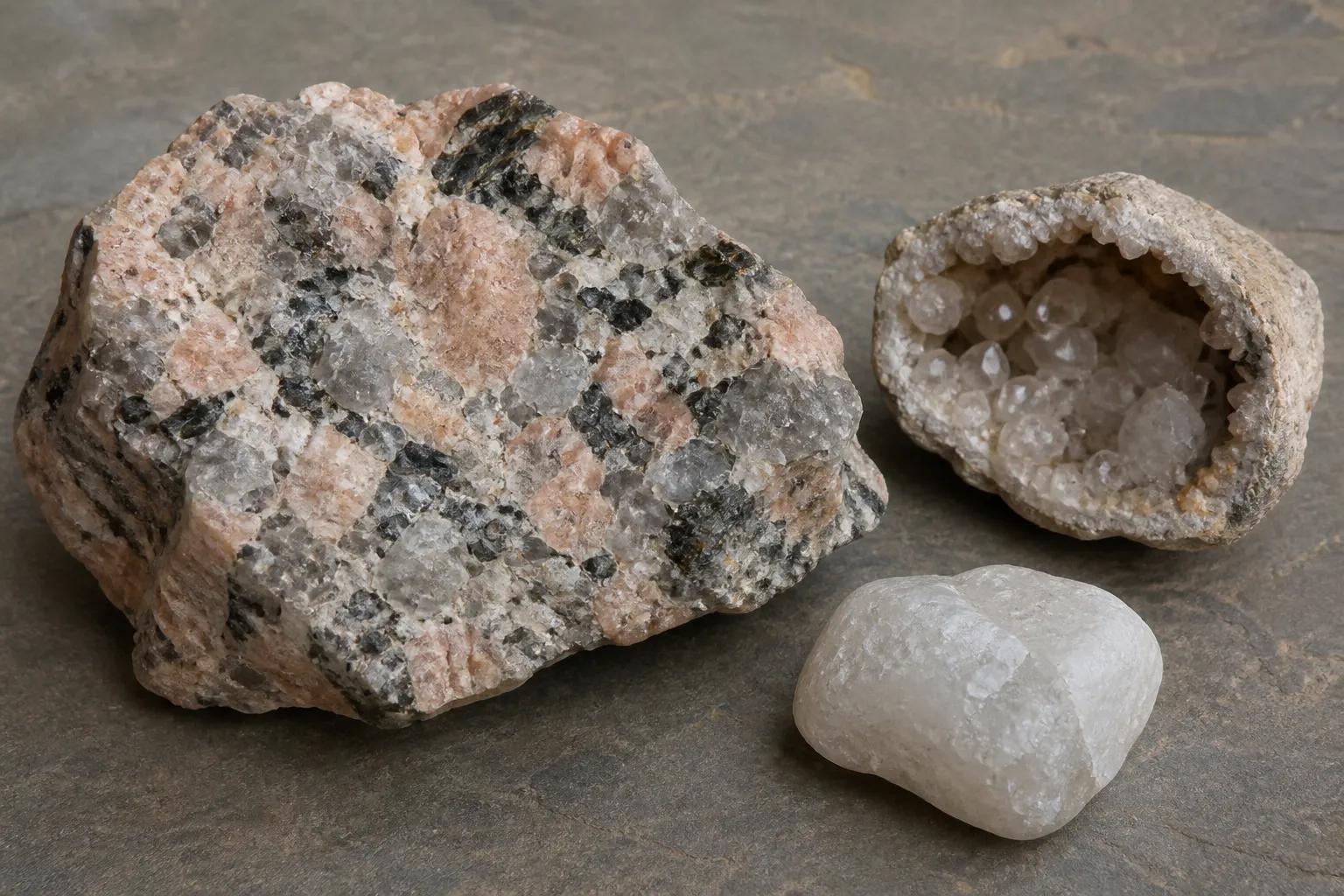
Granite shows several interlocking minerals, while quartz may occur as visible crystals or as a massive piece with no obvious external crystal shape.
A crystal is defined from the inside out
Scientifically, a crystal is a solid whose atoms are arranged in an orderly, repeating pattern. That internal structure can influence flat faces, consistent angles, cleavage, hardness, and other physical properties.
When a mineral grows into open space, its internal order may be expressed as a recognizable external shape, called its crystal form or habit. Quartz often grows as a six-sided prism with pyramid-like terminations. Halite may form cubes, and garnet may develop many-faced equant forms.
Growth is rarely ideal. Neighboring crystals, a narrow vein, changing fluids, weathering, or later breakage can interrupt the external shape. A massive milky quartz pebble is still made of crystalline quartz even when it does not resemble a point. Conversely, an object cut and polished into a six-sided tower did not necessarily grow in that shape.
“Crystal” is also used more broadly in shops and everyday speech for polished mineral and rock objects. That usage can be socially familiar without being a precise identification. If accuracy matters, record both the seller’s label and a material description such as “polished purple quartz candidate” until the identity is supported.
One specimen can carry all three ideas
Consider a quartz-lined geode. The rounded outer body is a rock. The lining may contain the mineral quartz. Individual well-formed points projecting into the cavity are quartz crystals. Those statements describe different scales of the same object.
Granite provides another example. The hand sample is a rock. Its gray glassy grains may be quartz minerals, its pale blocky grains may be feldspars, and its dark flakes may be mica. Each grain has an internal crystalline structure, even though crowding prevented most grains from developing complete external faces.
A single loose quartz point is simpler: it is a crystal of the mineral quartz. Calling it a “rock crystal” is also historically established as a name for transparent colorless quartz; it does not turn the specimen into a multi-mineral rock.
How to describe an unknown find
Start at the scale your eyes can support.
- Look for multiple components. Contrasting grains, pebbles, layers, or veins suggest a rock or a specimen containing more than one material.
- Look for repeated geometry. Several consistent faces or repeated angles may be natural crystal form. One flat surface might instead be cleavage, a fracture, a cut, or a polished face.
- Describe texture. Record whether grains are interlocking, rounded, layered, glassy, porous, or too fine to see. Texture often helps classify a rock before every mineral is known.
- Separate the object from its parts. “Gray coarse-grained rock with glassy grains and black flakes” is more useful than forcing the whole object into the name of one visible grain.
- Keep commercial shape separate from natural growth. Note polishing, carving, drilled holes, molded seams, or a uniform manufactured surface.
Our guide to six clues that matter more than color shows how luster, grain, form, existing breakage, hardness, and heft can strengthen that description.
What a photograph can—and cannot—settle
A clear image can show whether a specimen appears fine-grained or coarse-grained, whether it has repeated faces, and whether several materials are visible. It may support a rock-family label or a ranked list of possible minerals.
A photograph cannot reveal atomic structure or chemical composition. It cannot reliably tell whether a clear object is natural quartz, another transparent mineral, or manufactured glass. Weathering, coatings, polish, and lighting can hide the very surfaces needed to tell those possibilities apart.
StoneScout’s built-in field guide lets you compare candidate materials by their physical properties, chemistry, care, and common lookalikes. Use that reference to refine the wording of your observation, not to turn a visual resemblance into proof. Photo identification works best as a careful shortlist.
Do not break, grind, taste, heat, or apply acid to an unknown specimen. Leave fibrous, powdery, crumbly, strongly staining, or mine-waste-associated material undisturbed and seek local expert guidance. An accurate category is useful, but it is never worth creating dust or destroying the evidence you were trying to understand.
The cleanest labels often combine levels: “granite rock containing visible quartz and feldspar grains,” “quartz crystal on matrix,” or “polished material sold as crystal; exact identity unconfirmed.” Those descriptions say what you know, preserve what you do not, and make the next observation easier.
Sources
- What is the difference between a rock and a mineral? — U.S. Geological Survey
- Rocks and Geology — U.S. Geological Survey
- All Sorts of Quartz — Smithsonian National Museum of Natural History
- Minerals and their physical properties — National Park Service
- Crystal shape and internal structure — The Open University
- Minerals, crystals, and amorphous materials — Gemological Institute of America