
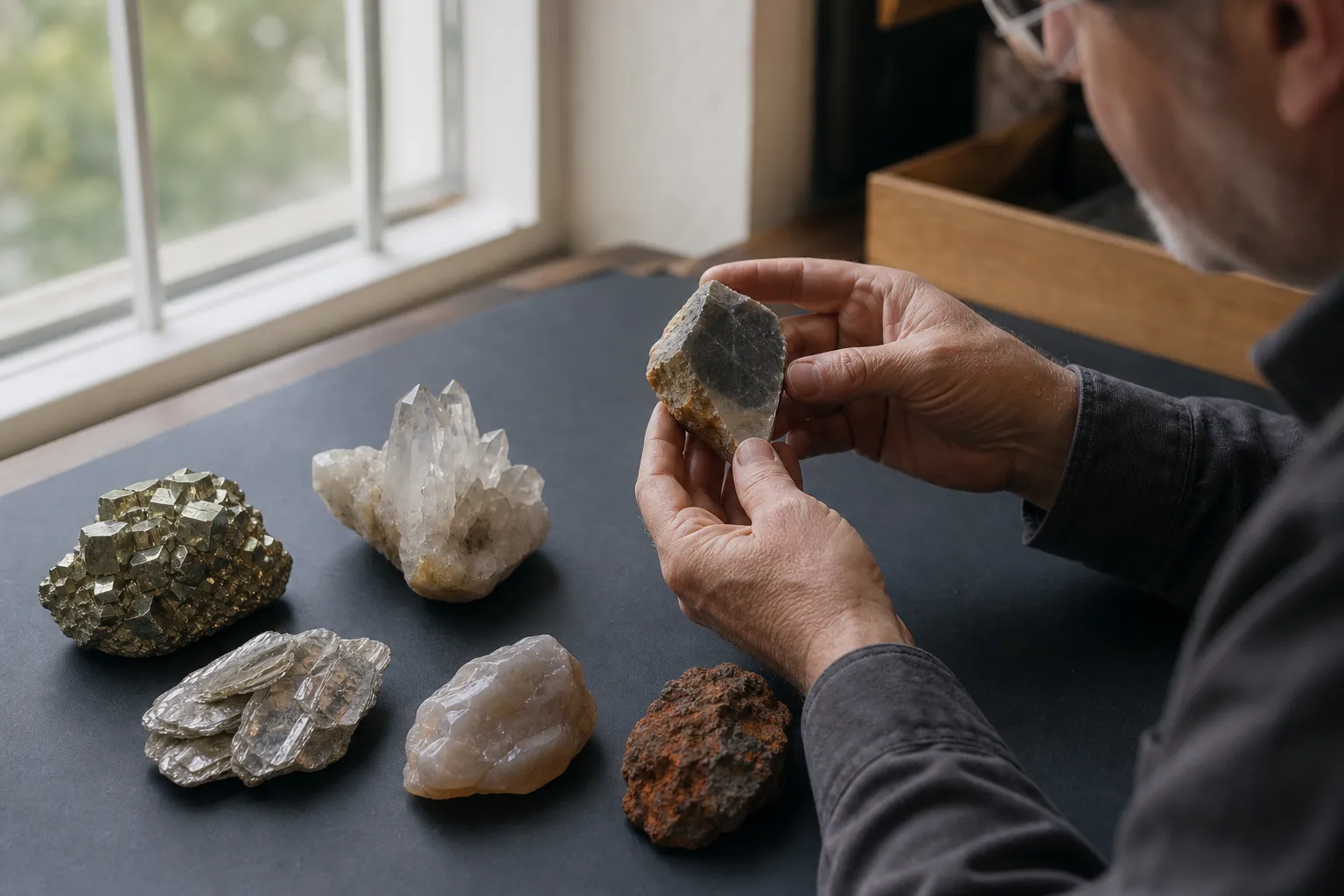
Luster is the way a mineral surface reflects light. It is not the specimen’s color, and it is not simply the amount of sparkle. A black mineral can look glassy, metallic, or dull; a pale mineral can look pearly, waxy, silky, or brilliant.
That makes luster useful when color points in too many directions. The challenge is that luster is descriptive. You learn it by comparing surfaces under controlled light, using broad categories first, and accepting that weathering or a mixture of minerals may produce more than one answer.
The most reliable opening question is simple: does this surface reflect like metal, or not?
Set up the observation
Use a dry specimen, a dark or neutral background, and diffuse daylight from one side. A bright window out of direct sun works well. Turn the specimen slowly while keeping your eyes on one surface. You are watching how the highlight moves and what the surface looks like just outside that highlight.
Compare more than one existing face. A weathered exterior may be earthy while an exposed crystal face is glassy. A cleavage surface may look pearly while rough areas look dull. Record both rather than choosing the most dramatic view.
Do not break, chip, polish, or wet a specimen to improve the observation. Water deepens color and can make a dull surface look temporarily glossy. Polishing describes the finish applied by a person as much as the material beneath it.
Start with metallic or nonmetallic
Metallic luster
A metallic surface reflects light in the manner of metal: opaque, strongly reflective, and metal-like even though its color may be brassy, steel gray, bronze, or nearly black. Pyrite and galena are familiar examples. Tarnish or weathering can reduce the reflection, creating what guides sometimes call submetallic luster. If a brassy surface suggests precious metal, compare pyrite and gold as a complete evidence pattern rather than letting shine decide.
Do not call a rock metallic because it contains a few glittering flakes. Granite can flash where mica catches the light, but the rock as a whole does not reflect like a piece of metal. Focus on a single mineral grain if it is large enough, and describe how much of the specimen shares the effect.
Nonmetallic luster
Nonmetallic does not mean dim. Many nonmetallic minerals reflect strongly, but the reflection resembles glass, pearl, wax, resin, silk, or an earthy surface rather than metal. Once you are confident that the surface is nonmetallic, a more specific family can narrow the description.
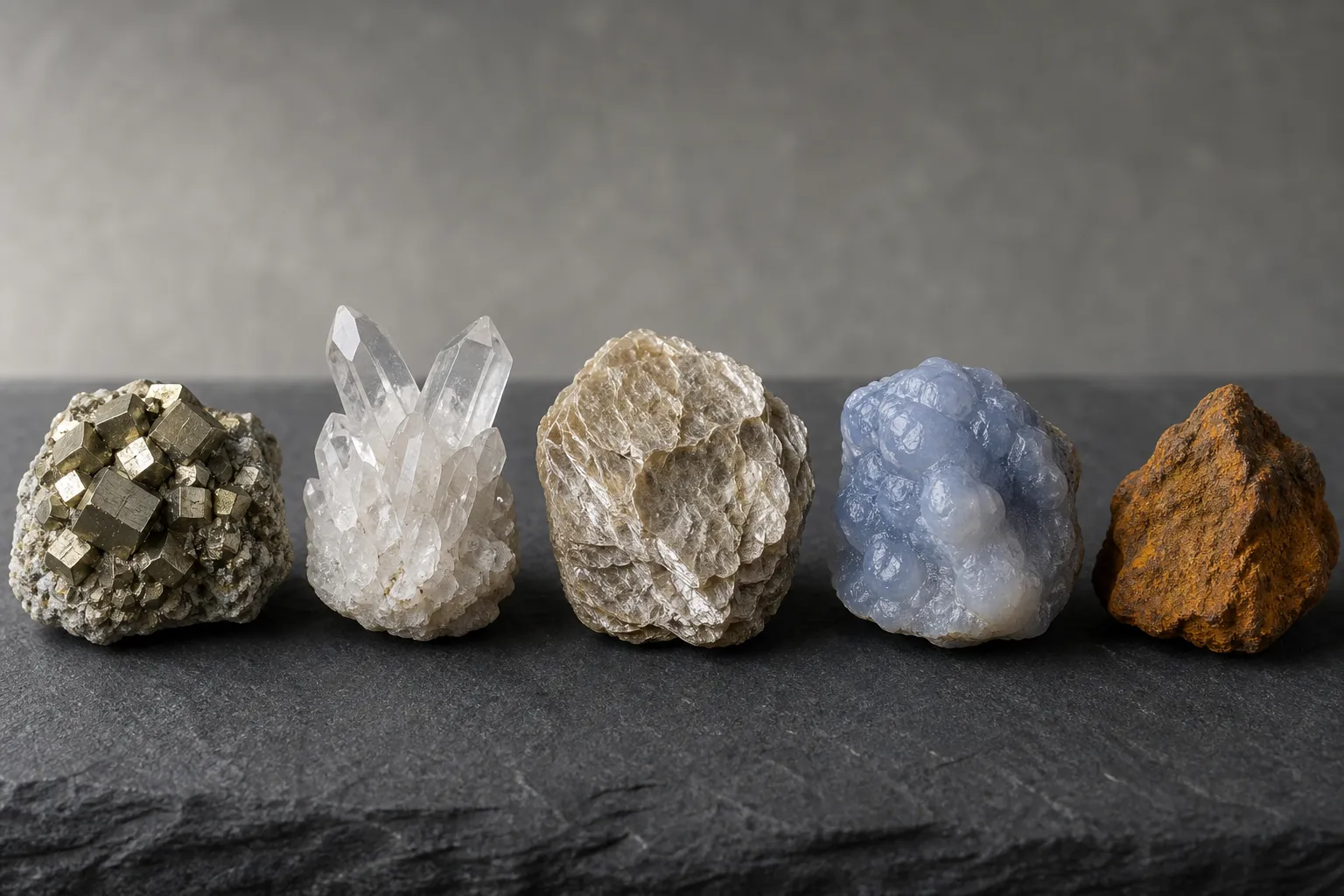
From left: a teaching lineup of metallic, glassy, pearly, waxy, and dull or earthy surface examples.
Common nonmetallic luster words
Glassy or vitreous
Vitreous means glass-like. Clear quartz commonly shows this luster on crystal faces and unweathered fracture surfaces. A vitreous mineral can be colorless, colored, transparent, translucent, or even nearly opaque. The clue is the quality of the reflected light, not whether you can see through it.
Weathered glass can also look vitreous, of course. Luster can support quartz as a candidate, but it cannot prove that a fragment is natural or identify quartz by itself.
Pearly
Pearly surfaces show a soft, layered reflection reminiscent of the inside of a shell. It is common on cleavage surfaces of sheet-like minerals such as muscovite and on some feldspars. Tilt the surface and look for a subdued glow that seems to sit slightly below or across thin layers.
One bright flat face does not automatically mean pearly. It could be vitreous, polished, or simply catching a large window reflection.
Waxy or greasy
A waxy luster resembles the low, soft sheen of candle wax; a greasy luster can look as though the surface carries a thin film of oil, even when it is clean and dry. Microcrystalline quartz varieties such as chalcedony are often described as waxy, while some massive quartz surfaces can appear greasy.
Do not apply wax or oil to test the comparison. Observe the untreated surface.
Silky
Silky luster comes from many fine parallel fibers or slender crystals reflecting together. The highlight may sweep across the specimen like light on satin. Fibrous gypsum can show this effect.
Fibrous appearance is also a reason for restraint. Do not rub, brush, scratch, cut, or break an unknown fibrous specimen. Some naturally occurring fibrous minerals require expert identification and careful handling; a distant photograph is safer than producing loose material.
Resinous
Resinous luster resembles hardened tree resin: warm, somewhat glassy, but softer and less crisp than ordinary glass. Sphalerite is a common mineral example. The word describes the optical impression, not the presence of organic resin.
Adamantine
Adamantine describes an unusually brilliant, high-intensity nonmetallic luster. Diamond is the classic example, and some other minerals can approach it. This is not a synonym for “sparkly” or “beautiful.” A faceted cut can multiply reflections, so use the term cautiously on jewelry or polished material.
Dull or earthy
A dull surface produces little distinct reflection. An earthy surface resembles unglazed clay or compacted soil and may scatter light from countless tiny grains. Weathered iron-rich coatings and very fine-grained mineral masses often look earthy.
Dull is still information. It may describe a coating rather than the interior material, so note where the surface changes instead of scraping the coating away.
Luster is different from transparency
Transparency asks whether light passes through the material. A transparent mineral lets you see through it clearly; a translucent one passes light but obscures detail; an opaque one does not pass light through an ordinary edge or thickness.
Luster asks what reflected light does at the surface. Quartz may be transparent or opaque while retaining a broadly vitreous luster. Metallic minerals are generally opaque, but “opaque” alone does not make a surface metallic.
Keep the two observations separate in your notes:
Pale green, translucent at thin edges, with a glassy luster on flat faces and a dull weathered rind.
That description preserves more evidence than “shiny green crystal.”
Five common traps
- Sparkle: A few mica flakes or crystal points can flash without giving the whole rock a metallic or glassy luster.
- Wetness: Water fills tiny surface irregularities, deepens color, and strengthens reflections. Judge the ordinary dry surface.
- Polish: A tumbled or cut face may be glossy because of its finish. Look at an unpolished existing area if one is available.
- Weathering: Tarnish, oxidation, and an earthy rind can hide the luster of the material beneath. Describe the rind; do not remove it.
- Mixed grains: A rock may contain metallic, glassy, and pearly grains together. Assign luster to visible components rather than forcing one word onto the entire rock.
Our guide to six clues beyond color places luster alongside grain, crystal form, breakage, hardness, and heft. Those clues become persuasive as a pattern, not as isolated labels.
Photograph the reflection honestly
A still image freezes one lighting angle, so luster can disappear or become exaggerated. Avoid direct flash and hard midday sun. Use soft side light, keep the surface dry, and take a few candidate frames while tilting the specimen slightly. Submit the one that shows a representative highlight without featureless white glare.
StoneScout analyzes one selected photo per scan. The rock-identification photo guide explains how to choose that frame. Because a photograph cannot show the reflection moving, you can also enter the luster you observed as a physical detail. StoneScout uses that evidence to help compare possible matches; it does not turn a descriptive word into proof.
Let the whole specimen disagree with you
If the first candidate is expected to be metallic but the clean, ordinary surface is glassy, do not reinterpret the reflection to protect the name. Reconsider the candidate. Also reconsider the observation: perhaps you described one grain in a mixed rock, a polished face, or a weathered coating.
Luster does not establish chemical composition, natural origin, treatment, gem identity, or value. Similar reflected-light effects occur in unrelated minerals and manufactured materials. When the distinction affects safety, a purchase, or a valuable specimen, preserve the object and ask a qualified expert.
The skill is not memorizing an impressive vocabulary. It is learning to move a specimen through soft light, compare like surfaces, and say exactly what the reflection does—even when the honest answer is “between glassy and waxy” or “metallic only in a few grains.”
Sources
- Minerals and their physical properties — National Park Service
- Minerals, rocks, and the limits of color — U.S. Geological Survey
- Natural mineral gemstones and identifying characteristics — U.S. Geological Survey
- Gem Stones of the United States — U.S. Geological Survey
- Safe work practices for crystalline silica — CDC/NIOSH