
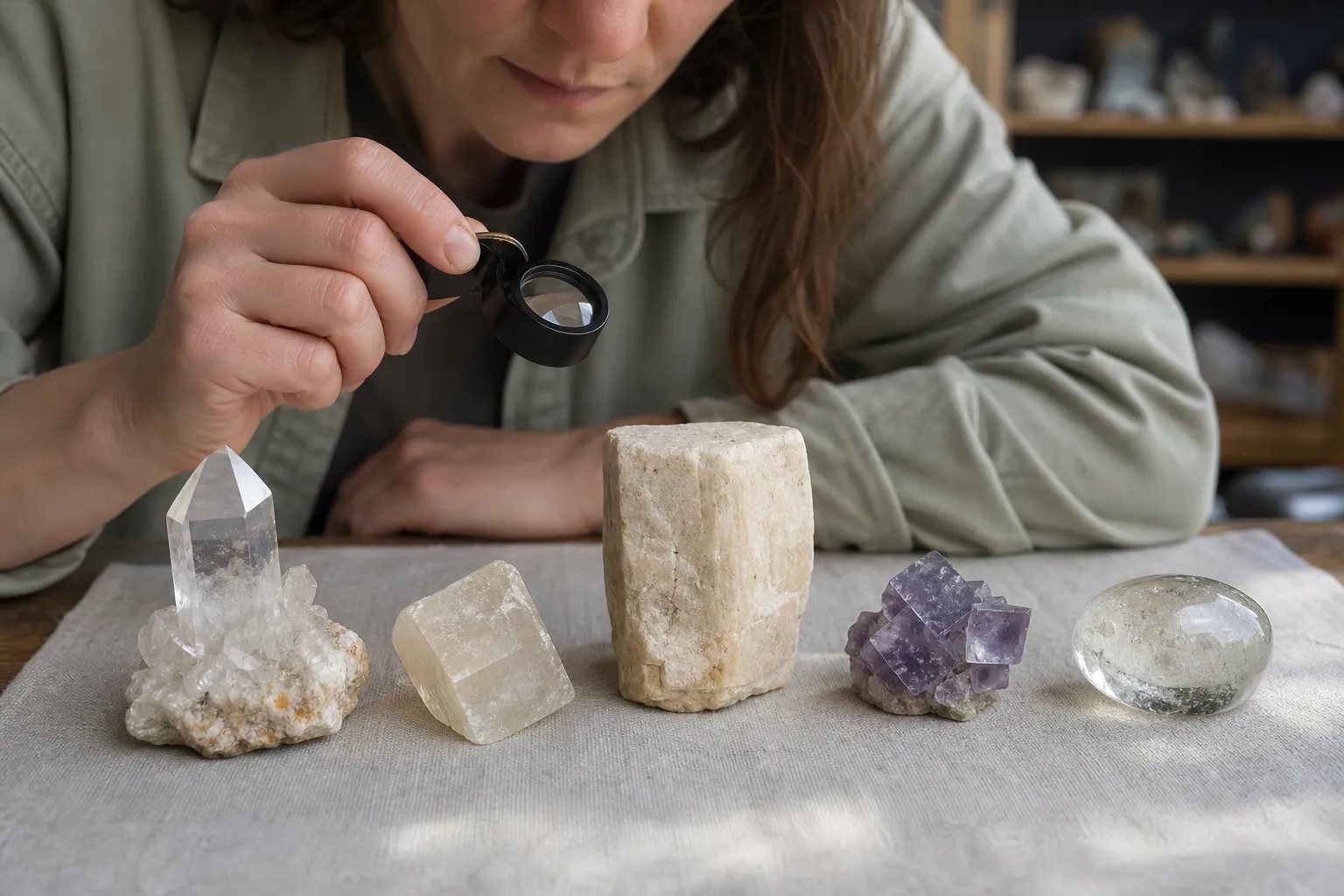
Clear quartz looks so familiar that it is easy to identify too quickly. A pale glassy crystal becomes “quartz,” a purple cube becomes “amethyst,” and a rounded translucent pebble becomes “crystal” before anyone has checked how it grew or broke.
Quartz is common and wonderfully variable, but appearance alone leaves room for calcite, feldspar, fluorite, gypsum, manufactured glass, and other materials. The safest approach is to ask which candidate explains the same complete set of observations: form, luster, existing breakage, relative hardness, texture, and context.
Build the quartz case first
Quartz is silicon dioxide, SiO₂. The University of Minnesota’s mineral reference lists a Mohs hardness of 7, no cleavage, characteristic conchoidal fracture, and glassy luster in crystals. Well-developed crystals are commonly six-sided prisms with pyramid-like ends, while massive and microscopic forms may show no recognizable points at all.
Color does not settle the question. Pure quartz is colorless, but varieties include milky, smoky, rose, purple amethyst, and yellow citrine. Quartz composed of crystals too small to distinguish can appear waxy rather than glassy and includes materials such as chert, agate, and jasper.
Before naming an unknown quartz, look for a compatible pattern:
- a nonmetallic surface that may be glassy, waxy, or dull depending on form and weathering;
- no repeated parallel cleavage planes;
- curved, shell-like fracture on edges that were already broken;
- hardness near 7 on a sound, unweathered portion; and
- where crystals are well formed, a six-sided prismatic habit rather than cubes or slanted blocks.
Not every quartz specimen shows every clue. Crowded growth hides external form, a weathered rind hides luster, and a mixed rock can place quartz beside softer minerals. Missing evidence should lower confidence rather than invite a destructive test.
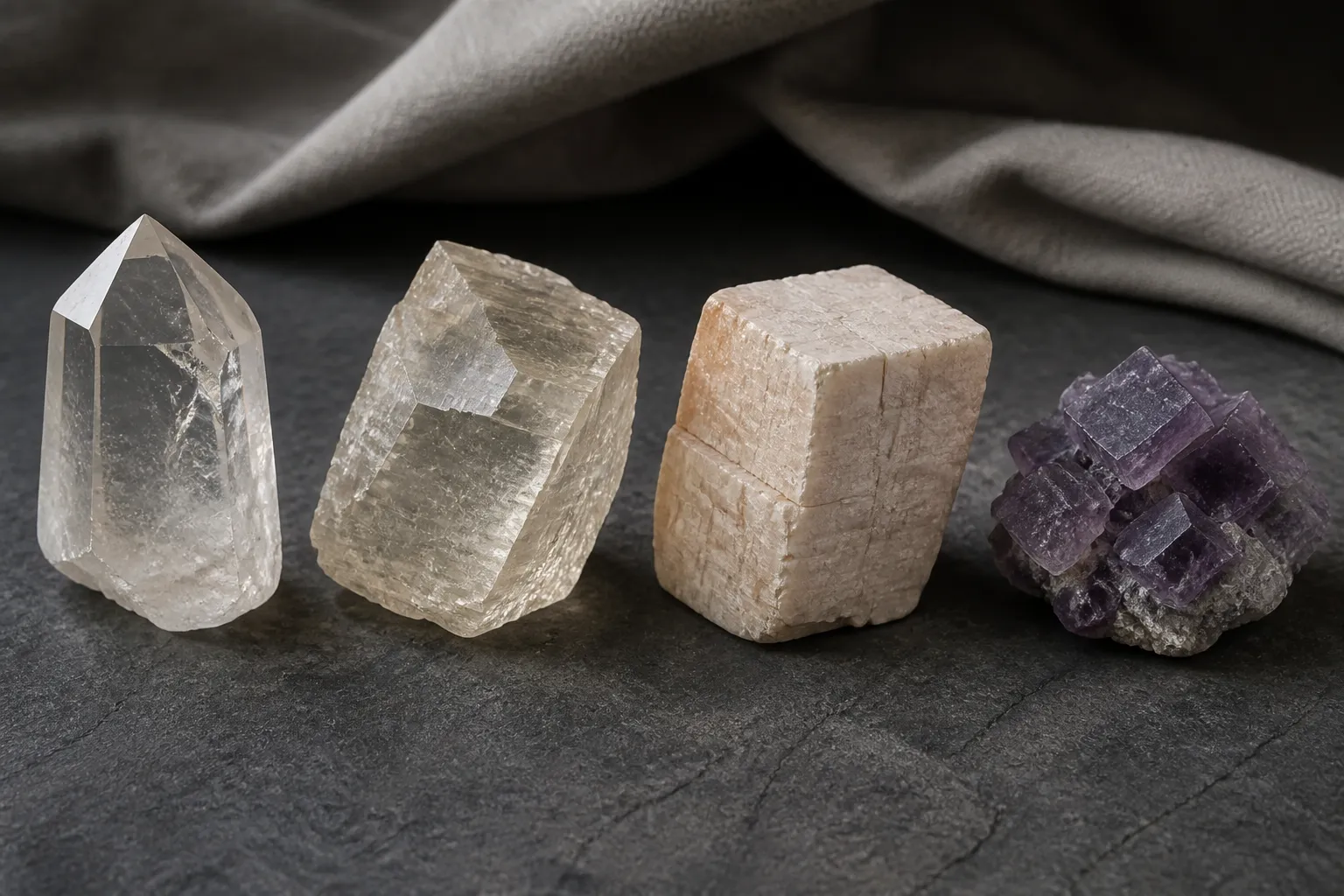
Crystal habit and existing surfaces can narrow a shortlist, but real specimens are less tidy than a teaching lineup.
Calcite: glassy, pale, and much softer
Clear or white calcite can share quartz’s glassy luster, and some calcite crystals can look pointed from a distance. Existing breakage is often the strongest visual separation. Calcite has excellent cleavage in three directions, producing repeated slanted rhombohedral surfaces. Quartz has no cleavage and tends to fracture in curved shells.
Calcite’s Mohs hardness is about 3, far below quartz at 7. On an ordinary, known-safe, expendable specimen, a careful relative-hardness comparison can therefore be decisive. Do not scratch a display crystal, polished object, jewelry, or unknown powdery material.
Geology references often mention calcite’s reaction with dilute acid. StoneScout does not recommend applying acid to an unknown. Cleavage and a properly controlled hardness comparison usually provide safer home observations, and an expert can choose an appropriate analytical method when the answer matters.
Feldspar: blocky faces instead of curved fracture
Quartz and feldspar commonly occur together in granite, pegmatite, and metamorphic rocks. Both can be pale, glassy, and hard enough to resist many metal objects, so color and a casual scratch attempt are poor separators.
Feldspars typically show two cleavage directions meeting near right angles. That creates blocky surfaces that repeat through the specimen. Plagioclase may also show fine, straight parallel striations on some cleavage faces. Quartz lacks cleavage; its existing broken surfaces are more irregular or conchoidal.
Do not mistake a quartz crystal’s flat growth faces for cleavage. A crystal face bounds the outside of a crystal as it grows. Cleavage repeats through the material along internal planes of weakness. Turn the specimen and look for several related surfaces before deciding which one you see.
Fluorite: cubes, cleavage, and purple confusion
Purple alone cannot separate amethyst from fluorite. Fluorite commonly forms cubes, while well-developed quartz forms six-sided prisms. Fluorite also has perfect cleavage in four directions and a Mohs hardness of 4, compared with quartz at 7.
Broken fluorite may display triangular faces that combine into octahedral shapes. Quartz does not cleave into those repeated planes. Fluorescence can occur in fluorite, but the name is not a promise that every specimen will glow, and fluorescence by itself is not an identification.
If the piece is carved, tumbled, or broken into an irregular chip, the original crystal habit may be gone. Preserve fluorite as a candidate until another safe property supports it.
Manufactured glass: the hardest visual trap
Quartz and glass can both be transparent, glassy, and conchoidally fractured. A rounded glass pebble can even acquire a frosted, weathered exterior that resembles a natural beach stone. A single photograph may not separate them.
Manufactured clues can include a molded seam, a flattened base, flow-like swirls, highly uniform color, or round bubbles. None is universal. Natural quartz can contain mineral, fluid, or gas-bearing inclusions, so “I see a bubble” is not a complete argument for glass. Likewise, glass can be bubble-free.
The structural difference is fundamental: quartz is crystalline, while ordinary glass is amorphous, meaning its atoms do not have the long-range repeating order of a crystal. Confirming that distinction may require optical or laboratory methods when visible evidence is ambiguous—especially for a cut stone, purchase, or authenticity claim.
Other pale crystals worth keeping on the list
Gypsum can form clear blades or plates but is very soft, with a Mohs hardness near 2 and prominent cleavage. Halite can be clear and shows cubic cleavage, but never taste an unknown specimen. Soluble, contaminated, treated, or misidentified material does not belong in your mouth.
Garnet and topaz can also overlap with some quartz colors and transparency. Their crystal forms, cleavage, density, and optical properties differ, but a polished gem may conceal the easiest field clues. For jewelry or consequential value questions, leave the stone intact and use a qualified gemologist or laboratory.
A safe sequence for narrowing the shortlist
- Photograph the intact specimen. Use diffuse light and include the whole piece, useful surfaces, and scale.
- Study shape before color. Look for six-sided prisms, cubes, slanted rhombs, blocky near-right-angle surfaces, or evidence of manufacture.
- Compare existing breakage. Record curved fracture versus repeated cleavage without making a new break.
- Check the context. A grain inside granite, a crystal lining a cavity, a landscaping fragment, and a rounded beach object carry different possibilities.
- Use hardness only when appropriate. Follow a controlled relative-hardness procedure only on a common, known-safe, expendable specimen. Stop if the surface is coated, fibrous, crumbly, valuable, or scientifically important.
- Ask what remains unexplained. A good identification accounts for every observation, not just the prettiest resemblance.
Luster helps describe the surface, but “glassy” is not the same as “made of glass.” The term tells you how light reflects; several different minerals can share it.
StoneScout’s built-in field guide can help compare quartz candidates with their physical properties and common lookalikes. A photo result should still remain a ranked starting point. It cannot measure hardness, confirm cleavage on a hidden face, reveal atomic order, or certify that a polished object is natural quartz rather than glass or another mineral.
Never use acid, flame, taste, licking, grinding, or deliberate breakage to force an answer. Do not brush or scratch unknown fibrous, powdery, crumbly, strongly staining, or mine-waste-associated material. When safety, authenticity, or meaningful money is involved, preserve the specimen and ask an appropriate expert.
Quartz earns confidence by matching a pattern: compatible form, no cleavage, conchoidal fracture, and high relative hardness. If the pattern is incomplete, “possible quartz” is a stronger conclusion than a certain name built from color alone.
Sources
- Quartz — University of Minnesota Common Minerals
- Calcite and aragonite — University of Minnesota Common Minerals
- Potassium feldspar — University of Minnesota Common Minerals
- Plagioclase feldspar — University of Minnesota Common Minerals
- Fluorite — University of Minnesota Common Minerals
- All Sorts of Quartz — Smithsonian National Museum of Natural History
- Minerals, crystals, and amorphous materials — Gemological Institute of America
- Safe work practices for crystalline silica — CDC/NIOSH