
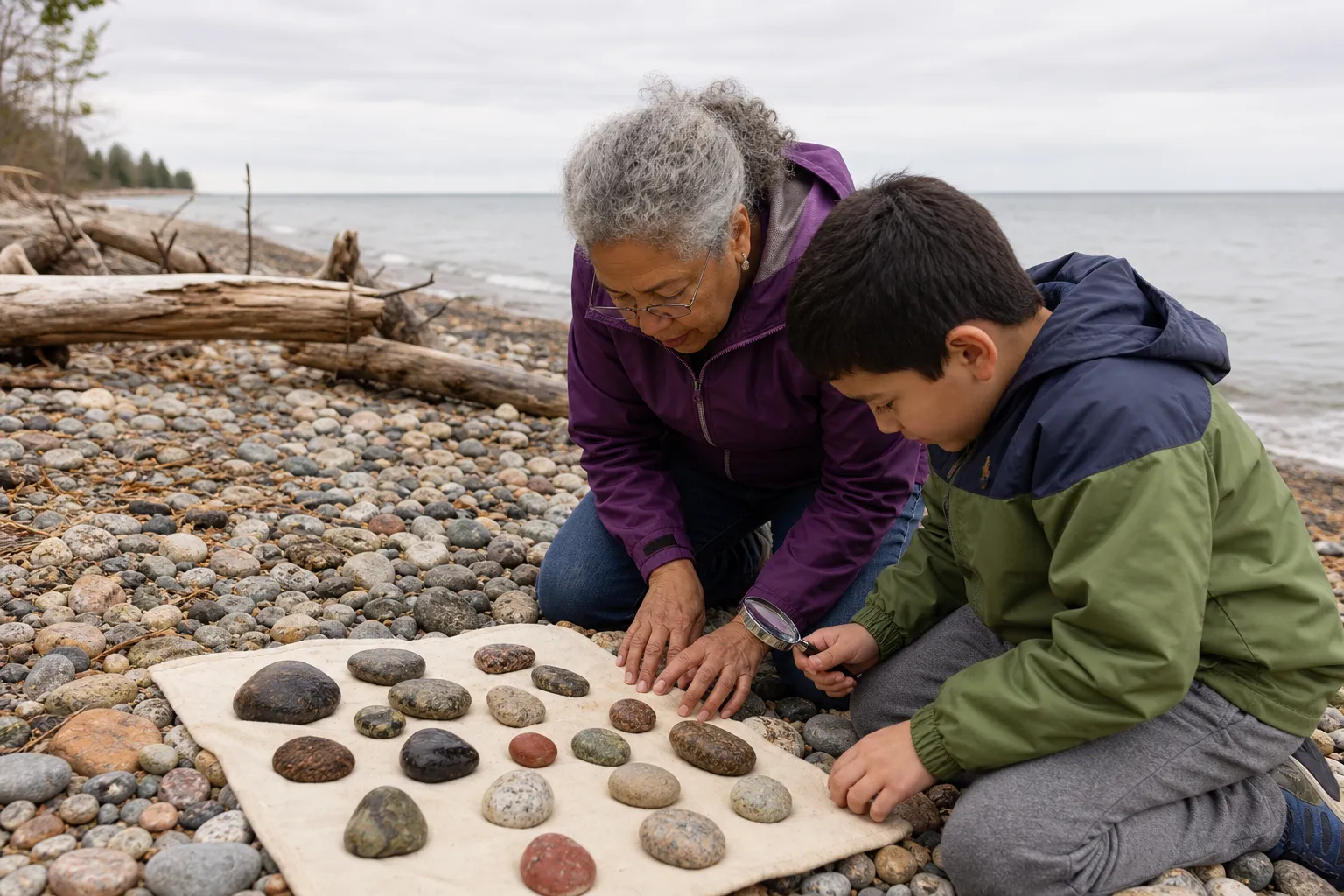
A Great Lakes beach can place dark volcanic rock, pink granite, fossil coral, quartzite, and a piece of old bottle glass within a few steps of one another. The mix feels random until you consider two powerful sorting systems: glaciers carried material across the region, and waves keep eroding, rounding, and rearranging it.
There is no single stone list that fits every shore. A rocky beach on the Keweenaw Peninsula does not expose the same source material as a sandy Lake Erie shore or the dunes of southern Lake Michigan. The best identification begins with the lake, the side of the lake, nearby bedrock and bluffs, and whether the pebble arrived naturally at all.
Use the groups below as a regional shortlist—not as permission to name a stone from color alone.
Why the beaches contain such a mixed collection
During repeated glacial periods, ice sheets moved across the Great Lakes region, eroded bedrock, carried fragments, and left sediment behind as they retreated. The U.S. Geological Survey reports that glacial deposits cover the surface across much of the region, while ancient igneous, metamorphic, and sedimentary rocks are exposed more directly in the Superior upland.
Michigan EGLE calls rocks transported away from their source glacial erratics. Where a Great Lakes wave cuts into a glacial moraine or bluff, finer sediment can wash away and leave a lag of resistant pebbles and cobbles. Rivers, eroding bedrock, construction fill, and longshore transport add more material. Waves then round corners and make unrelated stones converge on the same smooth shape.
That is why “round gray beach rock” is not an identification. Texture, grain size, banding, existing breakage, fossils, and local geology carry more information than the outline.
Dark, fine-grained stones: basalt and its lookalikes
Basalt is a dark, fine-grained volcanic rock. Along parts of Lake Superior—especially volcanic shores of the Keweenaw and North Shore—it can dominate the cobbles. Michigan Technological University’s beach-rock guide shows Keweenaw basalt ranging from nearly uniform gray to spotted, porphyritic, or vesicle-rich varieties.
Look for a dark gray to brown-black body with crystals too small to separate by eye. Small rounded holes may be original gas vesicles. If those cavities later filled with pale minerals, the rock is amygdaloidal basalt and may show light spots against a dark background. Some basalt weathers reddish where iron-bearing minerals oxidize.
Do not call every dark pebble basalt. Chert can be equally dark but tends to look smoother and may show a curved, glass-like fracture on an existing chip. Slate may split along closely spaced flat planes. Dense industrial slag can be dark and bubbly, while coal or clinker may feel unusually light. A hand lens and an honest note about texture are more useful than a black-rock guess.
Gabbro and diabase are related dark igneous candidates with larger or more visible crystals than typical basalt. On a wave-worn surface, the transition can be hard to judge from one photo.
Speckled and banded crystalline stones: granite and gneiss
Granite-like pebbles commonly show several interlocking minerals: pale or pink blocky feldspar, gray glassy quartz, and black mica or amphibole. Their grains look randomly intergrown rather than arranged in sedimentary layers. Large parts of the Canadian Shield and Ontario contain granitic and metamorphic rocks, and glaciers carried fragments into Great Lakes deposits.
Gneiss can contain a similar mineral set but organizes it into wavy light and dark bands. A rounded gneiss cobble may show the bands clearly on one side and look merely speckled on another. Turn it through a full rotation before deciding.
“Granite” is often used casually for almost any coarse, light-colored crystalline rock. A photograph may support the broader phrase granitic rock without resolving the exact proportions of quartz and feldspar needed for a formal rock name. That is a useful level of confidence for a beach find.
Hard silica-rich stones: quartzite, quartz, chert, jasper, and agate
Silica-rich pebbles resist weathering and can survive long transport, but several types overlap visually.
- Quartzite is a hard metamorphic rock formed from quartz-rich sandstone. It is commonly white, gray, pink, red, or purple. Look for a dense “sugary” texture in which fracture passes through a fused mosaic rather than around loose sand grains.
- Massive quartz may be milky white, clear at thin edges, gray, or iron stained. It lacks visible sedimentary grains and can show glassy to greasy luster and conchoidal fracture.
- Chert is very fine-grained silica, commonly gray, brown, black, cream, or red. It can be smooth and waxy and may show sharp curved fracture on an edge that was already chipped.
- Jasper is an opaque, often iron-rich silica material whose red, yellow, brown, green, or patterned body can overlap with chert and quartzite.
- Agate is banded chalcedony. Lake Superior agates commonly display iron-colored red, orange, brown, cream, and white bands, but an unpolished exterior may reveal only a few lines, waxy luster, translucency at a thin edge, or small pits.
All five are hard enough that casual scratching is a poor first move. Their names also cross boundaries between mineralogy, petrology, and lapidary tradition. Focus first on visible grains, band geometry, opacity, and existing fracture. Our six-clue field guide shows how to combine those observations.
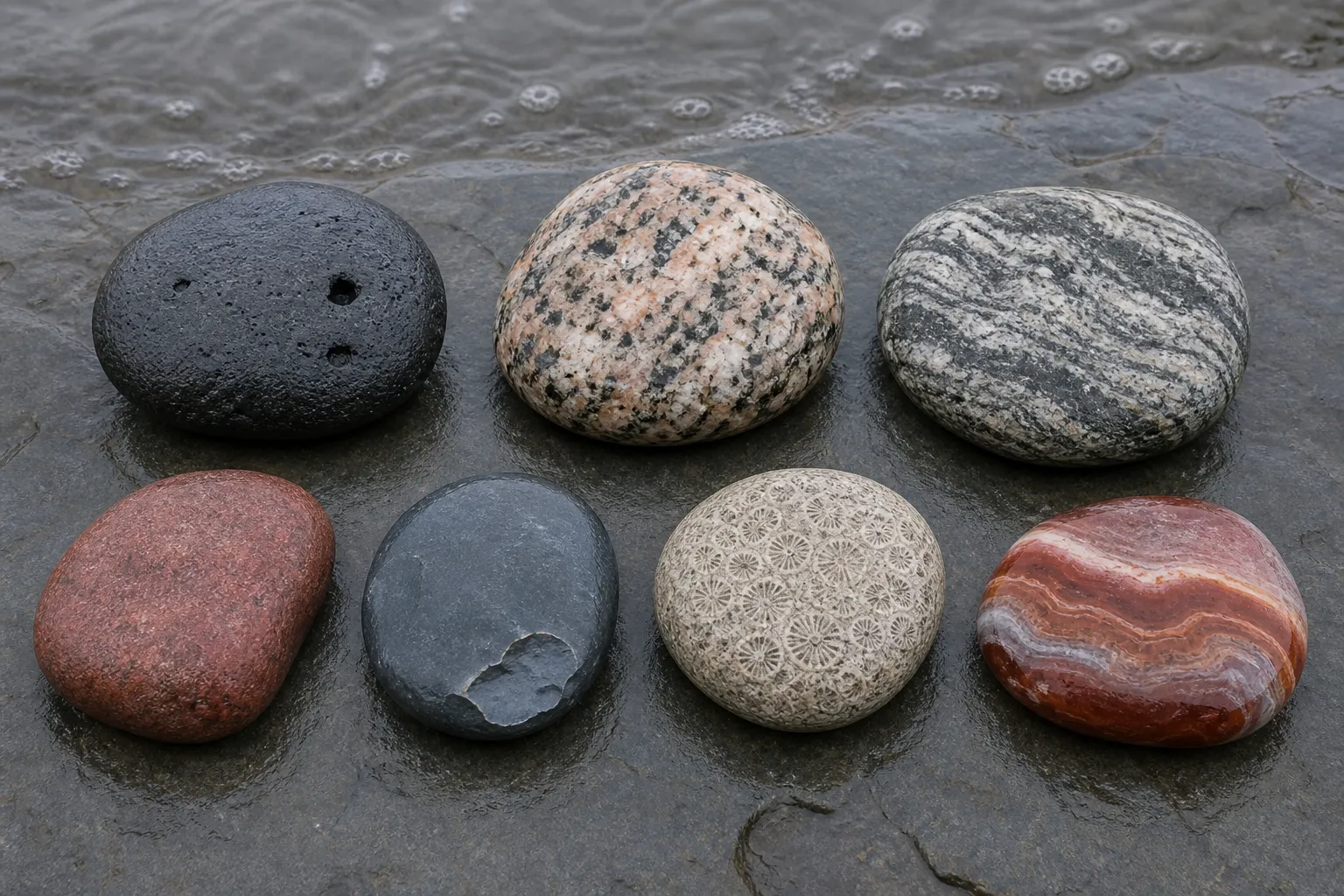
These are representative candidates, not a promise about one beach. Water rounding removes corners and other diagnostic features, so compare textures rather than memorizing silhouettes.
Sandstone, limestone, dolostone, and shale
Sedimentary rocks reflect the bedrock of many Great Lakes shores.
Sandstone commonly shows sand-size grains and may be tan, red, brown, gray, or white. Individual layers can vary in grain size or color. Strongly cemented sandstone can survive as rounded cobbles; weaker pieces may feel gritty and shed grains. Do not rub a crumbly unknown vigorously or create dust.
Limestone and dolostone are often pale gray, buff, cream, or brown. Their texture ranges from very fine to visibly crystalline, and they may contain fossils or fossil fragments. A carbonate pebble can resemble pale quartzite when wave polished. Standard geology manuals may recommend acid for separating carbonate rocks from silica rocks, but do not apply acid to an unknown beach specimen. Existing texture, fossil evidence, relative hardness on an appropriate expendable sample, and expert review are safer routes.
Shale is fine grained and commonly gray, black, reddish, or greenish. It may split along bedding into thin pieces. A smooth dark pebble with no remaining layers can be difficult to separate visually from slate, argillite, chert, or some manufactured materials.
Fossils are structures, not surface decorations
Great Lakes carbonate rocks may preserve corals, crinoids, brachiopods, bryozoans, or other ancient life. A fossil pattern should continue into the rock rather than sit like paint on top.
The best-known example is Michigan’s Petoskey stone, a wave-rounded piece containing the extinct colonial rugose coral Hexagonaria. Wet surfaces often reveal repeated polygonal cells with radiating lines and darker centers. Michigan EGLE also identifies Favosites, a tabulate coral with many smaller packed cells, as the fossil often called a Charlevoix stone.
Those names are regional and biological, not generic labels for every patterned limestone. A modern coral fragment, a different fossil colony, an oolitic texture, or manufactured pattern may look similar in a phone image. Photograph several cells with scale and preserve the specimen. Never pry a fossil from bedrock or an outcrop.
Fossils are also subject to ownership and collecting rules. A loose fossil may be legal to collect in one location and fully protected a short drive away.
Regional specialties are clues to geography
Some stones are strongly associated with particular source regions but were spread beyond their original outcrops.
Lake Superior agates formed in and around ancient volcanic rocks and were redistributed by glaciers. Minnesota designated the Lake Superior agate its state gemstone in 1969. Iron-bearing colors are familiar, but banding—not redness alone—is the defining clue.
Puddingstones around Michigan and Ontario are conglomeratic rocks, commonly with red jasper pebbles enclosed in a pale quartz-rich matrix. The individual clasts should have real boundaries and differing textures; they are not spots painted onto one material.
Greenstone, amygdaloidal basalt, iron-formation pebbles, and copper-bearing rocks are particularly relevant around parts of Lake Superior. Their presence on another Great Lakes shore may reflect glacial transport, imported landscaping gravel, or a human-made object. Locality changes probability, but it does not prove origin.
Names such as “lightning stone” and “Yooperlite®” also appear in regional collecting culture. These terms refer to specific appearances or commercial identities, not broad categories for any veined or fluorescent pebble. Fluorescence is a supporting observation and requires suitable eye and skin precautions; it is not necessary for the basic beach-stone sorting in this guide.
Human-made material belongs on the shortlist
Great Lakes shorelines also preserve industrial and domestic history. Slag, clinker, brick, concrete, ceramic, and glass can all become rounded enough to look geologic.
Useful manufactured clues include:
- many smooth bubbles or stretched cavities in a glassy body;
- a molded seam, flat manufactured face, or repeating texture;
- uniform bottle-glass color through a curved translucent shard;
- brick-red ceramic with consistent fine pores;
- concrete containing several aggregate grains in a uniform cement; or
- metallic droplets, cindery texture, or unusually low heft in industrial material.
Natural basalt can contain vesicles, natural quartz can fracture like glass, and conglomerate can resemble concrete. One clue is never enough. Do not handle sharp glass, metal slag, tar, or material with oily residue. Photograph suspicious industrial material in place and wash hands after ordinary shoreline handling.
A five-minute beach-stone routine
- Record the exact context. Note the Great Lake, nearest public access, beach type, nearby bluff or bedrock, and whether landscaping gravel is present.
- Photograph before sorting. Take the whole stone dry with a scale. Wetting can reveal bands and fossils, but also darkens color and can hide luster, so record a wet view separately.
- Find the texture. Look for visible interlocking grains, fine uniform mass, fossil cells, sand grains, bands, vesicles, or human-made bubbles.
- Turn every side. Wave rounding may preserve the best clue on only one face.
- Compare a group, not just a color. Decide whether the observations fit a dark volcanic rock, a crystalline rock, a fine silica-rich stone, a sedimentary rock, a fossil-bearing carbonate, or manufactured material.
Do not strike stones together, break them, grind them, taste them, or use acid or flame. Avoid unstable bluffs, slippery bedrock, ice, and high waves. A storm may expose new material, but observe only after conditions are safe.
Check collecting rules before anything leaves the beach
Seeing a stone is not the same as having permission to take it. Shore ownership and management around the five lakes include private property, municipalities, counties, states and provinces, tribal and First Nations lands, and federal protected areas. Rules can change at each boundary.
Michigan EGLE’s statewide rockhounding guidance tells collectors to obtain private-property permission, check local rules, and limits collection on Michigan state-owned land to 25 pounds total per person per year. That number does not override a stricter site rule, apply across other states or Canada, or create permission on private, tribal, municipal, or federal land.
The National Park Service generally prohibits possessing, disturbing, or removing mineral resources in park units. That includes Great Lakes sites such as national parks and national lakeshores unless a specific exception or permit applies. Apostle Islands National Lakeshore, for example, explicitly says rocks and cultural artifacts may not be collected.
Check the current page or contact the land manager for the exact access point before collecting. If ownership is unclear, leave the stone, take photographs, and record the location. Leave all potential cultural or archaeological material exactly where it is and report a significant find to the appropriate land manager.
What a photo and field guide can support
A photo can support a ranked rock-family shortlist when it shows texture, scale, several sides, and context. It cannot measure hardness or density, reveal grains below resolution, confirm a fossil species, distinguish every natural glass from industrial glass, or establish legal provenance.
StoneScout’s built-in field guide can help compare candidates such as granite, basalt, gneiss, quartzite, agate, jasper, and other common materials. Use its physical-property descriptions to decide what to observe next. Treat a photo result as a ranked starting point, and let the location narrow possibilities without turning it into proof.
Great Lakes beaches are valuable precisely because they mix so many histories. A careful label might read “wave-rounded, fine-grained dark volcanic-rock candidate from a permitted Lake Superior beach” or “fossiliferous carbonate pebble photographed on Lake Michigan; exact coral unconfirmed.” That wording keeps the geology, evidence, and collecting context together.
Sources
- Great Lakes geologic mapping framework — U.S. Geological Survey
- Geology of Indiana Dunes National Park — U.S. Geological Survey
- Rock and mineral identification and Michigan collecting guidance — Michigan EGLE
- Michigan fossils and how to find them — Michigan EGLE
- Beach rocks of the Keweenaw Peninsula — Michigan Technological University
- Common Minnesota rocks — Minnesota Geological Survey
- Minnesota state gemstone: Lake Superior agate — Minnesota Secretary of State
- Recreational collection of rocks and minerals in national parks — National Park Service
- Gathering and collecting rules — Apostle Islands National Lakeshore