
Agate, jasper, and chalcedony are often displayed as three neighboring kinds of stone. That is convenient for a shop tray, but it hides their relationship. They are not three unrelated minerals with clean borders.
Chalcedony is the shared fine-grained silica material. Agate is chalcedony recognized mainly by its banding. Jasper is an opaque, impure silica-rich material whose name is used less consistently. A specimen can combine translucent agate bands with opaque jasper-like zones, and two careful people may choose different names for a borderline piece.
The family resemblance is real. So are the gray areas.
Chalcedony is the foundation
Quartz is silicon dioxide, SiO₂. In familiar quartz crystals, individual crystals can grow large enough to show their six-sided form. Chalcedony is built from silica crystals too small to distinguish with the unaided eye. It commonly looks smooth, massive, and waxy rather than like a cluster of quartz points.
At the microscopic scale, the description is more interesting than “tiny quartz.” Gemological Institute of America research describes chalcedony as a fibrous cryptocrystalline silica material composed mostly of alpha quartz intergrown with moganite, another silica structure. Those extremely fine intergrowths help produce chalcedony’s compact texture.
Chalcedony is therefore best treated as a broad material term. Unbanded gray, white, blue, brown, or colorless chalcedony may simply be called chalcedony. Other names emphasize color, pattern, inclusions, or traditional use: carnelian is orange to red chalcedony, chrysoprase is green, and onyx is traditionally chalcedony with parallel bands.
Those variety names do not describe separate mineral species. They describe recognizable expressions of closely related silica material.
Agate is the banded branch
Agate is generally defined as banded chalcedony. Smithsonian and GIA references describe bands that can follow the wall of a cavity, form concentric or angular “fortification” patterns, or vary in color, clarity, porosity, and microscopic texture.
Many agates begin in open spaces such as gas cavities in volcanic rock. Silica-bearing fluids enter the space, and silica is deposited inward from the walls. Agate can also occur in veins and some sedimentary settings. The broad process is understood, but GIA notes that the detailed mechanism producing agate’s rhythmic nanoscale textures is still not fully settled.
Color is secondary to structure. Iron oxides can supply rust, red, orange, or brown tones, while other inclusions can create darker colors. An undyed agate may be mostly white and gray. A brightly colored stone without recognizable banding is not automatically agate, and a subdued gray specimen with fine bands may be an excellent example.
Not every traditional name follows the strict “banded” rule. Moss agate, for example, is commonly named for branching or moss-like inclusions rather than true bands. That is a useful reminder that historical gem names do not behave like a modern biological classification chart.
Jasper is the opaque, inclusion-rich side
Jasper is commonly described as opaque, impure microcrystalline silica or chalcedony-rich rock. Iron oxides often produce familiar brick-red, ocher, brown, and yellow colors, but jasper can also be green, black, cream, or multicolored. Fine mineral grains and other inclusions make the material less translucent and can create mottled, spotted, brecciated, or landscape-like patterns.
The definition is not perfectly standardized. A GIA study of material sold as “Dalmatian jasper” notes that jasper nomenclature is not well coordinated between gemology and petrology. Depending on the reference, jasper may be treated as an opaque chalcedony variety, a kind of chert, or a silica-rich rock containing substantial non-silica material.
That disagreement matters in the marketplace. Some commercial names ending in “jasper” are attached to rocks that do not meet a strict gemological definition of jasper. “Dalmatian jasper,” for example, was found by researchers to be a feldspar-rich rock, and they recommended “Dalmatian stone” instead.
For a hand specimen, opaque and silica-rich with a compact texture is a reasonable starting description. It is stronger than assuming that every patterned opaque stone sold under a jasper name shares the same geology.
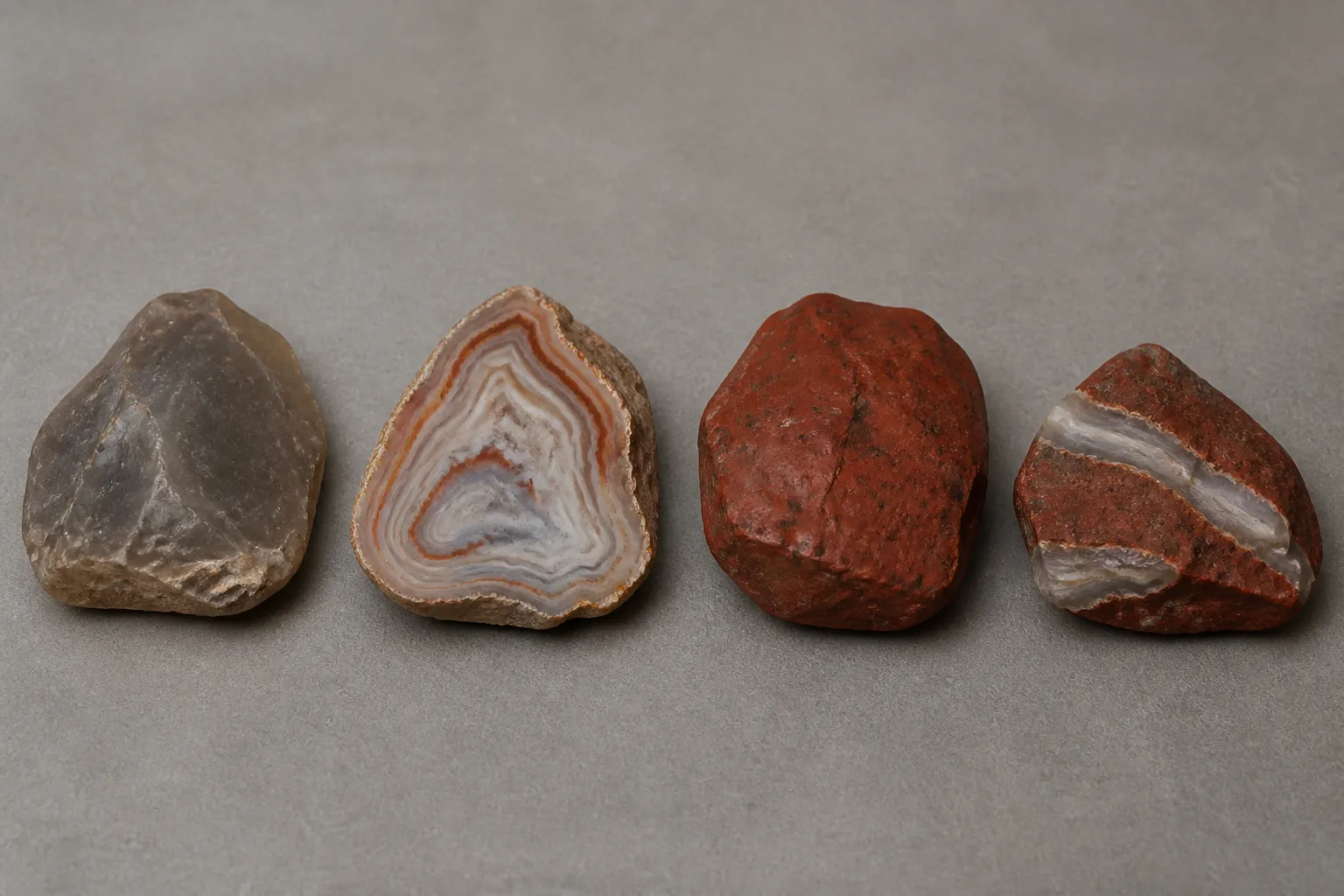
The names describe useful visual patterns, but natural specimens can bridge them. A transitional piece may reasonably be described as jasper-agate or mixed chalcedony.
The boundaries blur for good reasons
Imagine silica filling a cavity while fluid chemistry, porosity, crystal texture, and inclusions change over time. One layer may be relatively clear and translucent. Another may contain enough iron oxide or other fine material to become opaque. Later growth may return to translucent chalcedony.
The finished specimen does not need to respect a collector’s drawer labels. It may contain:
- fine, translucent agate bands around an opaque center;
- jasper-like red zones cut by pale chalcedony veins;
- unbanded chalcedony beside crystalline quartz; or
- patterns visible only where weathering or an old cut exposes the interior.
“Jasper-agate,” “jasp-agate,” or a plain description such as “opaque red silica with translucent chalcedony bands” can be more honest than forcing the whole object into one name. The descriptive phrase also preserves the evidence if the specimen later receives a more specific geological interpretation.
A practical visual comparison
Use several observations together:
| Question | Chalcedony | Agate | Jasper |
|---|---|---|---|
| What is the name emphasizing? | Fine-grained silica material | Bands within chalcedony | Opaque, impure silica-rich material |
| Typical light transmission | Often translucent at a thin edge, but variable | Bands may differ from translucent to opaque | Usually opaque |
| Typical pattern | Massive, cloudy, or unbanded | Concentric, parallel, angular, or irregular bands | Mottled, spotted, brecciated, scenic, or fairly uniform |
| Typical luster | Waxy to glassy on a fresh surface | Waxy to glassy | Dull to waxy, sometimes glassy when polished |
| Hardness | About 6.5–7 | About 6.5–7 | Commonly about 6.5–7, but inclusions can affect the whole rock |
Hardness will not neatly separate these materials because their silica frameworks overlap. Color will not do it either. Red material can be jasper, carnelian, iron-stained agate, or another rock; blue material can be natural or dyed chalcedony, glass, or something else.
Banding is most useful when it belongs to the stone rather than to an applied coating, a host-rock layer, or a reflection. Turn the specimen under diffuse light and follow each line around the surface. Agate bands commonly vary slightly and relate to a cavity or growth boundary. Perfectly printed-looking repetition, a molded seam, or color confined to surface cracks should move manufactured material or treatment higher on the shortlist.
Observe thin edges without changing the specimen
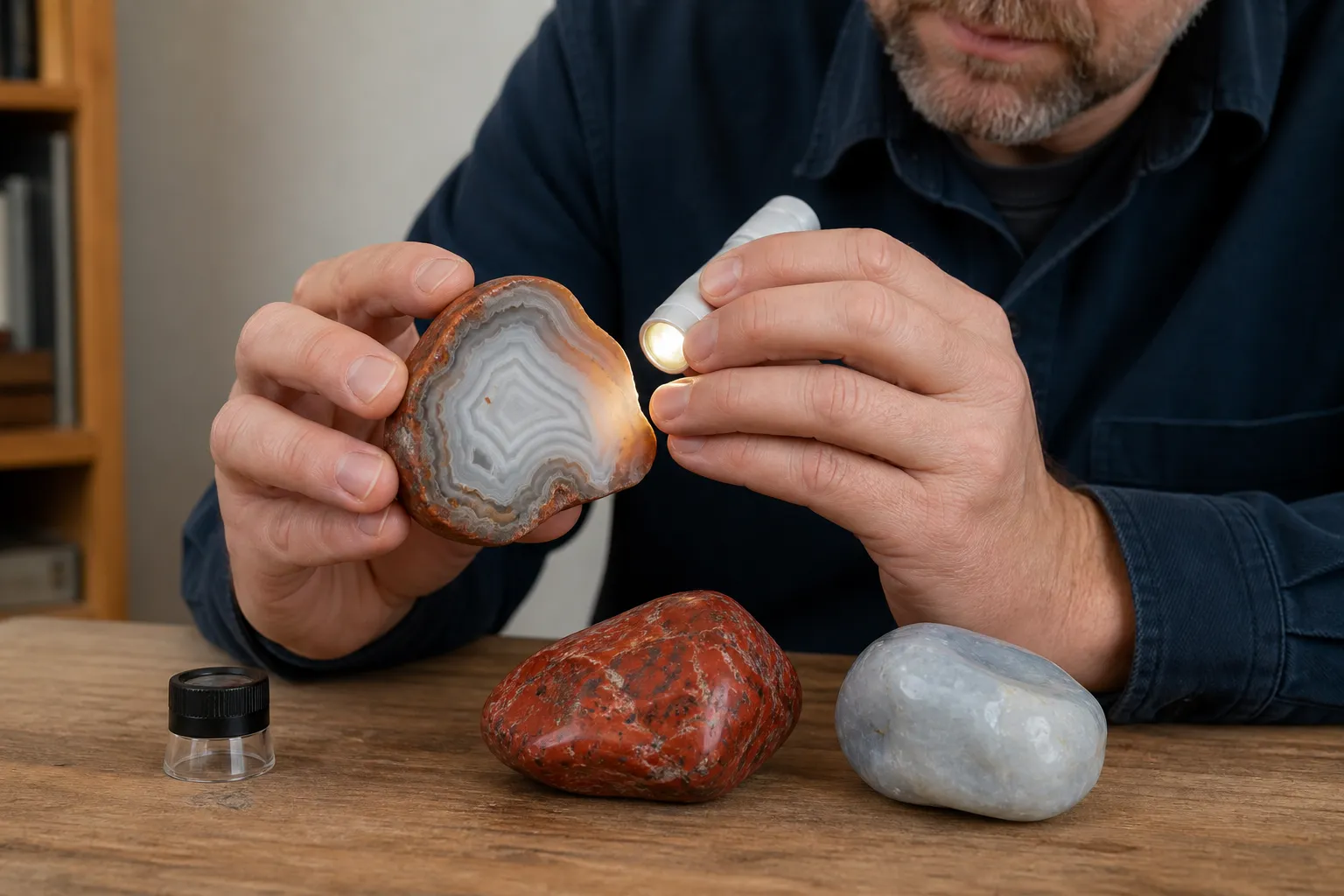
A small white flashlight can help compare light transmission. Work indoors or in shade, hold the stone over a padded surface, and place the light behind an already thin edge. Do not stare into the beam. Record whether light passes through the body, through only a few bands, or not at all.
This is a descriptive check, not a verdict. A thick agate may seem opaque. A thin chip of material called jasper may transmit a little light. A weathered rind can hide translucent chalcedony beneath it. Never break or grind a stone just to expose a “better” edge.
Study existing surfaces with a hand lens instead. Chalcedony and agate may show smooth conchoidal fracture, a waxy sheen, and no visible grains. Jasper can show similar fracture but may also look duller or reveal fine inclusions. If separate sand-size grains are plainly visible, consider quartzite, a cemented sedimentary rock, or another silica-rich rock rather than assuming chalcedony.
Our quartz lookalike guide explains why the broader quartz family can shift from glassy crystals to waxy, fine-grained material.
Polish and color can hide the best clues
Lapidary work reveals internal patterns, but it also removes weathered surfaces and natural shape. A polished cabochon may make agate bands obvious while concealing the cavity it once followed. An opaque jasper cabochon may resemble dyed chalcedony, glass, or a differently composed rock.
Chalcedony and agate have long been dyed. GIA’s gem-treatment guide shows that porous or fractured gem materials can accept strong color, and laboratory work may be needed to determine whether color is natural. Neon saturation, color concentrated along fractures, or a colored outer zone can justify suspicion, but none alone proves treatment from a photograph.
Use seller disclosures, locality, and treatment documentation when a purchase or value claim matters. A photo cannot certify natural color, locality, or trade identity, and a commercial variety name may be more specific than the available evidence supports.
Give a photo the right job
A strong photograph can show band shape, opacity at a thin edge, surface luster, grain visibility, weathering, and whether the specimen is rough, cut, or polished. Include one image dry, one in diffuse light, and a close-up with scale. If safe, add a separate frame showing a flashlight behind the thinnest natural edge.
StoneScout’s built-in field guide can help compare agate, red jasper, carnelian, onyx, quartz, and other candidates by physical properties and common lookalikes. Treat any photo result as a ranked starting point. It cannot resolve microscopic silica structure, quantify impurities, or decide which of several legitimate naming conventions should govern a borderline specimen.
Never use acid, flame, taste, licking, grinding, or deliberate breakage to settle the name. Do not create silica dust by sanding or cutting. Ordinary intact pieces are generally safe to handle, but lapidary work requires proper dust controls and equipment.
The most useful relationship is simple: chalcedony names the fine-grained silica material; agate highlights banding; jasper highlights opacity and impurities. Where the features overlap, describe the overlap. Nature loses nothing when a label becomes a careful sentence.
Sources
- Structures Behind the Spectacle: agate and chalcedony nanotextures — Gems & Gemology
- Quartz (variety agate) — Smithsonian National Museum of Natural History
- True Colors of “Dalmatian Jasper” — Gems & Gemology
- Rock and mineral identification: Lake Superior agates — Michigan EGLE
- An Introduction to Gem Treatments — Gemological Institute of America
- Safe work practices for crystalline silica — CDC/NIOSH