
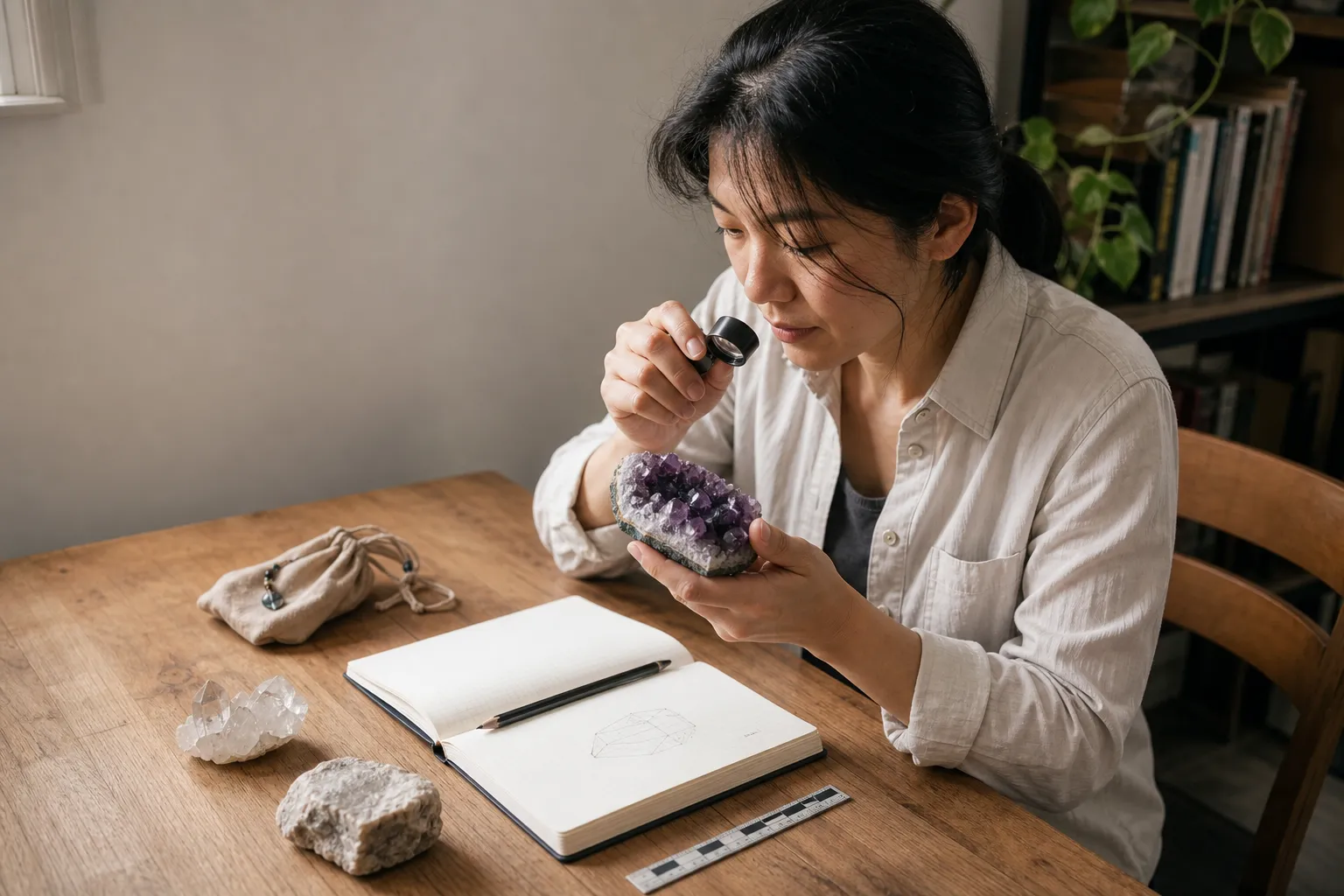
A stone can be meaningful without being medicine.
An amethyst inherited from a grandparent may represent steadiness. A piece of rose quartz may remind someone to act with kindness. A birthstone can connect a family to a month, place, or tradition. Those are real human uses of objects, and science does not need to invalidate them.
Science asks a different set of questions: What is the material? Which properties can be measured? Does a claimed health effect outperform a convincing comparison under controlled conditions? Confusion begins when a statement from one category is presented as proof in another.
The most useful approach is to keep mineral facts, cultural lore, personal meaning, and medical claims distinct.
What mineral science can measure
A mineral can be studied through its composition, internal structure, hardness, cleavage, fracture, density, optical behavior, and other physical properties. Quartz, including amethyst and rose quartz, is crystalline silicon dioxide, SiO₂. Calcite is calcium carbonate, CaCO₃. Their structures help explain why they respond differently to light, force, and other materials.
These properties are not matters of belief. Different observers using appropriate methods should be able to obtain compatible results. A specimen may still be difficult to identify, and a photograph may support only a shortlist, but the underlying question is testable.
Quartz also has a genuine piezoelectric response. Properly cut quartz components can resonate predictably in engineered electrical circuits, which is why quartz has been used in oscillators and timekeeping. The National Institute of Standards and Technology describes a historical quartz oscillator whose performance depended on an external circuit and careful control of temperature, pressure, and humidity.
That physical effect does not demonstrate that carrying a raw quartz point “balances” a body, transfers healing energy, or treats an illness. In physics, words such as energy, frequency, and vibration refer to quantities that can be defined and measured. Using the same words metaphorically does not establish the same mechanism.
Our guide to rocks, minerals, and crystals explains how composition and internal order differ from the everyday shop use of the word “crystal.”
What a crystal meaning is
Crystal meanings belong to history, culture, commerce, spirituality, and personal practice. They are not one fixed catalog handed down unchanged.
Amethyst is a good example. The Gemological Institute of America traces its name and lore to Greek and Roman associations with wine and clear-headedness, while later wearers connected it with royalty, religion, wit, and personal empowerment. Modern lists may emphasize calm or intuition. Those layers tell us about people and symbols; they do not change amethyst’s formula.
When you encounter a meaning, ask:
- Who is making the association? A specific religious or cultural tradition, a historical source, a modern author, a seller, or the owner of the stone?
- How old is the claim? “Ancient” is often used as a marketing shortcut. Look for a named period, place, text, or community.
- Is it descriptive or therapeutic? “Used as a symbol of courage” is different from “reduces blood pressure.”
- Is it universal? A stone may carry different meanings in different communities, or none at all.
It is more accurate to write “In one modern crystal-lore tradition, this stone is associated with…” than “This stone gives everyone….” It is also perfectly reasonable to record, “This stone reminds me of….” A personal association needs honesty, not clinical validation.
Material observations and personal associations can sit beside each other without being treated as the same kind of claim.
A simple ladder for judging claims
Before accepting or repeating a statement, identify what kind of support it would require.
- Material claim: “This specimen is amethyst.” Evidence may include color zoning, quartz properties, magnification, and—in consequential cases—gemological testing.
- Historical claim: “Amethyst was associated with sobriety in Greek and Roman lore.” Evidence should come from credible historical or gemological sources.
- Personal claim: “Holding this stone helps me pause before a difficult conversation.” That reports an individual experience, not a result guaranteed for others.
- General wellness claim: “A quiet ritual with this stone helps people feel calmer.” This needs a well-designed comparison that separates the object from expectation, setting, and the act of pausing.
- Medical claim: “This crystal treats anxiety, infection, cancer, or another condition.” This requires robust clinical evidence for safety and effectiveness. Testimonials, tradition, and mineral properties are not substitutes.
The more a claim could affect someone’s health, money, or decision to seek care, the stronger the evidence must be.
What controlled research can separate
A person can sincerely feel calmer during a crystal ritual. The difficult question is why.
Expectation, attention, learned associations, a comforting setting, and taking several quiet minutes may all affect subjective experience. The National Center for Complementary and Integrative Health defines a placebo effect as a beneficial outcome related to a person’s anticipation that an intervention will help. That does not mean the experience is imaginary. It means the experience alone cannot show that a particular stone caused a specific biological effect.
In a 2025 randomized controlled study, 138 adults followed a 14-day protocol using either rose quartz or a visually matched non-crystal placebo. Anxiety reductions appeared among believers regardless of which object they received. The researchers found no specific advantage for rose quartz over the placebo and concluded that expectation and conditioning better explained the reported change.
One study does not answer every possible question, but its design illustrates the central issue. To support a stone-specific treatment claim, the crystal would need to produce a reliable benefit beyond belief, ritual, normal symptom variation, and other comparison effects. Credible evidence for carrying or placing crystals as a treatment for disease has not been established.
Placebo-related effects also have limits. They can influence how some symptoms feel, but they are not evidence that an infection has cleared, a tumor has shrunk, a fracture has healed, or another underlying condition has been treated. A meaningful ritual may accompany evidence-based care; it should not replace diagnosis, medication, therapy, or urgent help.
Safety matters even when the practice feels gentle
“Natural” does not mean risk-free. A polished quartz pebble handled normally is very different from an unidentified mineral powder, mine specimen, or product intended for ingestion.
- Do not put unknown stones in drinking water, make “crystal elixirs,” lick specimens, or ingest mineral powders. Some geological specimens contain or release hazardous substances, and surface coatings or treatments may be unknown.
- Do not grind, drill, sand, heat, or deliberately break a specimen to “activate” it. Cutting many silica-rich materials can create respirable dust, and other minerals can contain mercury, arsenic, asbestos-form minerals, or radioactive elements.
- Wash your hands after handling unknown, dusty, old, or mine-associated specimens. Keep them away from food, children, and pets until they are properly identified and assessed.
- Treat promises of a cure, guaranteed results, secret frequencies, or instructions to stop medical care as danger signs. The U.S. Food and Drug Administration warns that unproven treatment claims can delay effective care.
If a specimen is fibrous, powdery, crumbly, strongly staining, or associated with mine waste, leave it undisturbed. If identity or safe handling matters, ask an appropriate geologist, museum professional, or laboratory before experimenting.
Use meaning without turning it into proof
You do not have to choose between wonder and accuracy. Try a two-column record for a meaningful specimen:
- Observed and sourced: tentative identity, physical properties, where it came from, care needs, and the source of any historical lore.
- Personal: who gave it to you, what it represents, how you use it as a reminder, and how your interpretation has changed.
Keep seller language in quotation marks when the identity or tradition is uncertain. If a purple stone was sold as “healing amethyst,” record that label separately from your own identification. Our quartz lookalikes guide shows why appearance alone may not settle the material question.
StoneScout’s field guide presents physical and chemical information separately from its Meaning/association notes. Read those association notes as lore, not as medical guidance. The separation is the point: a specimen can have a measurable geologic identity, a documented cultural history, and a personal place in your life without one category pretending to prove another.
Sources
- Amethyst History and Lore — Gemological Institute of America
- Quartz Oscillator — National Institute of Standards and Technology
- Placebo Effect — National Center for Complementary and Integrative Health
- Placebo effects in alternative medical treatments for anxiety — PubMed
- The Powerful Placebo — National Institutes of Health
- Common Questions about Medication Health Fraud — U.S. Food and Drug Administration
- Curatorial Care of Paleontological and Geological Collections — National Park Service
- Safe Work Practices for Silica — CDC/NIOSH