
Most ordinary rock questions do not need a laboratory. A clear photo, find context, and a few safe observations may be enough to call a beach pebble “probably basalt” or place a sparkly yard rock in the granite family.
Other questions carry a consequence. You may need to know whether a gem is natural or laboratory-grown, whether a strange metallic object is a meteorite, whether an unknown coating is safe to handle, or whether a specimen is scientifically important. In those cases, a plausible photo match is not the finish line.
The U.S. Geological Survey puts the limitation plainly: rocks and minerals are extremely difficult to identify from photographs and are best examined in person from all perspectives. The right next step may be an experienced hobbyist, a geologist, a museum specialist, a gemologist, or an analytical laboratory. They do different jobs.
Three levels of answer
Think first about the decision you need to make.
A field-level description
For learning, organizing a personal collection, or satisfying everyday curiosity, a cautious family-level or candidate-level description is often enough. “Fine-grained dark volcanic rock, probably basalt” can be useful without proving its exact mineral chemistry.
A good description should still explain uncertainty and competing possibilities. Photo identification is a starting point, not certification.
An in-person expert opinion
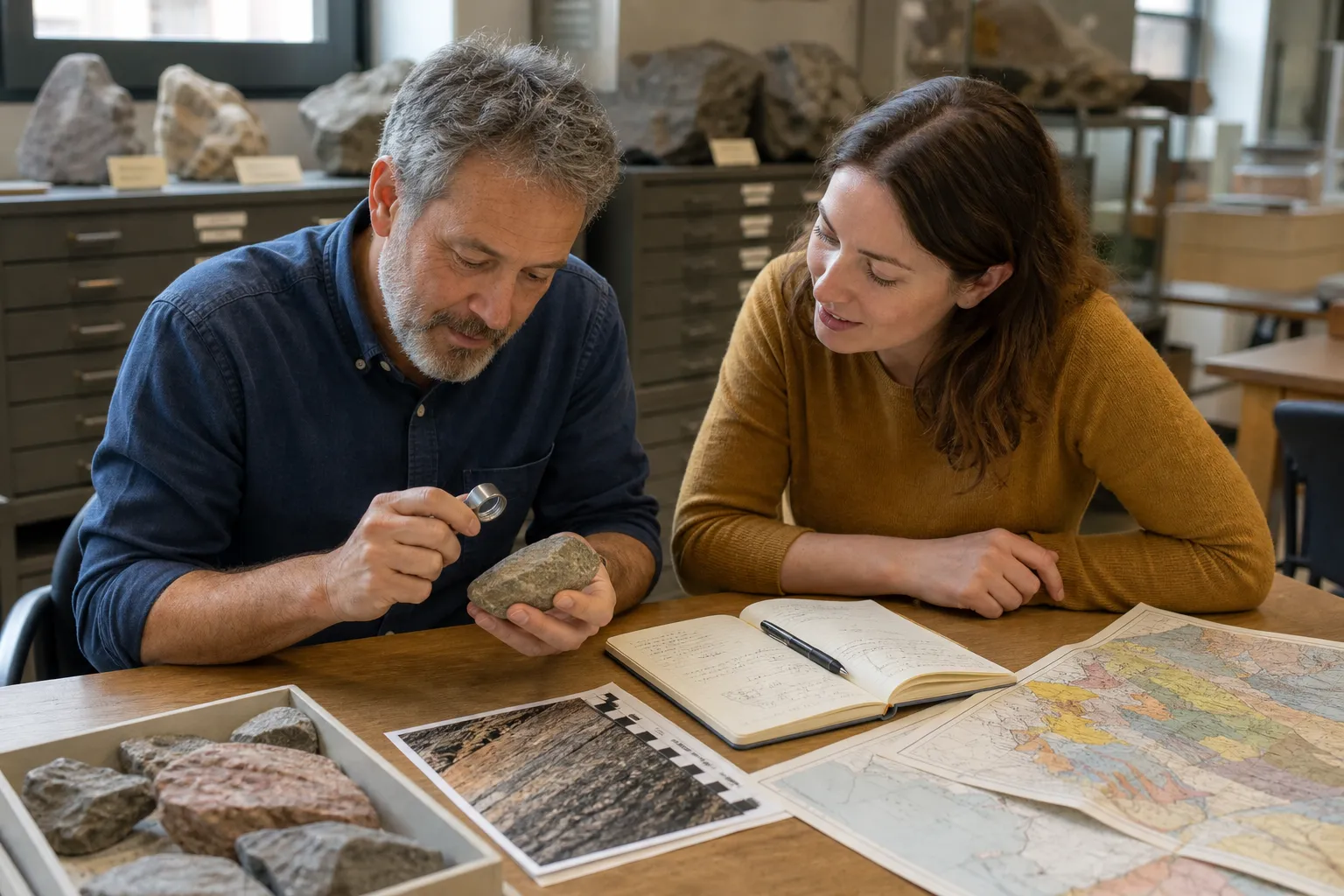
Ask an experienced person when the visible features do not fit together, the specimen is a complex rock rather than one mineral, local geology matters, or you want to learn which observation to make next. An expert can rotate the object, inspect grains under magnification, compare its heft, recognize texture, and notice a coating or manufactured surface hidden in photographs.
USGS suggests state geological surveys, natural science museums, college or university geology departments, rock shops, local gem and mineral clubs, and vendors at mineral shows as possible local resources. Contact them before visiting; not every organization identifies public submissions, and policies, fees, and expertise vary.
A documented laboratory result
Laboratory analysis is appropriate when the required answer depends on internal structure, composition, treatment, or origin rather than appearance alone. The result should match a real decision: a significant purchase, insurance documentation, scientific research, safe material management, or a claim that needs independent evidence.
A report is not automatically an appraisal. A laboratory may identify material or disclose detectable treatments without assigning market value, and a value opinion cannot be inferred from a mineral name alone.
Stop home testing and seek help when…
The specimen may be hazardous
Do not scratch, streak, brush, wash, grind, cut, smell closely, or deliberately break an unknown fibrous, powdery, crumbly, strongly staining, or mine-waste-associated specimen. Ores and processed geologic samples can involve silica, lead, arsenic, mercury, and other hazards. Isolate the object from children, pets, food areas, and repeated handling, and ask a local environmental or mineral professional how to proceed.
If there has been a spill or exposure, identification by photo is not emergency guidance. Contact the appropriate local health, poison-control, workplace-safety, or emergency service for the situation.
Damage would erase evidence or value
Leave polished gems, jewelry, delicate crystals, fossils, possible artifacts, historic objects, and sentimental or valuable specimens intact. Do not perform a streak test or scratch comparison merely to satisfy an online suggestion.
For a possible fossil or cultural object, the right expert is a paleontologist, museum, or archaeology authority—not a general gem lab. Keep the find location private until an appropriate professional advises you, and do not remove material from land without permission.
A meteorite claim matters
Most dense, magnetic, dark finds are terrestrial rocks or industrial material. USGS notes that meteorites are rare and that potential specimens need in-person examination. Magnet attraction alone is not proof; common Earth minerals and slag can also be magnetic.
Preserve the entire object and its find context. Do not polish a window, cut it, or grind it for a streak. Contact a university meteoritics program, natural history museum, or specialist who states that they accept public inquiries. Ask what photographs, measurements, and sampling—if any—they require before sending anything.
Authenticity, treatment, or money is involved
A photograph cannot reliably distinguish every natural gem from a synthetic, imitation, coating, dye, filling, heat treatment, or other enhancement. GIA explains that classical observation is sometimes insufficient and that spectroscopy and other advanced techniques may be needed for treated or synthetic material.
For a consequential purchase or sale, use an independent gemological laboratory whose report scope covers the material and question. Confirm in advance whether the service identifies species, natural versus laboratory-grown origin, detectable treatments, geographic origin, or none of those. These are separate conclusions.
The name must be defensible
Formal research, environmental work, construction decisions, legal disputes, museum records, and publication may require a reproducible method and written result. “Looks like” is not defensible evidence when another person must be able to audit the conclusion.
What an expert can add
An in-person geologist often begins without a machine. Context, mineral assemblage, grain relationships, weathering, structure, and comparison with mapped local units may resolve the practical question. A stereo microscope can reveal features that a phone photo compresses or hides.
When observation is not enough, the method should follow the question:
- Optical and gemological instruments can measure properties such as refractive behavior and reveal inclusions in transparent or cut material.
- Spectroscopic methods can help distinguish some natural, synthetic, and treated gem materials.
- X-ray diffraction (XRD) can identify crystalline phases and estimate mineral proportions in some rock, soil, and sediment samples.
- Chemical analysis can measure elements, but chemistry alone may not distinguish minerals that share elements in different structures.
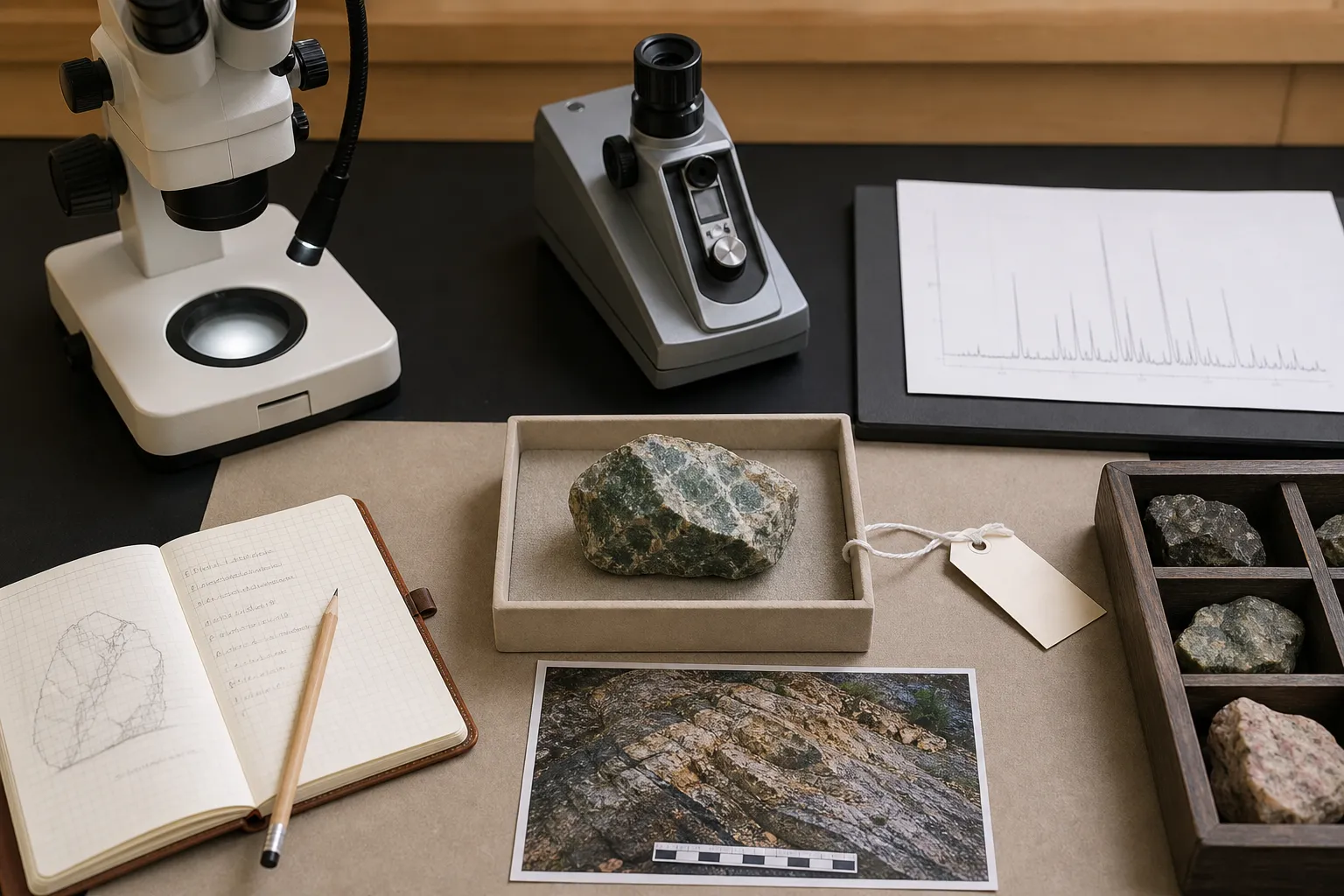
The method should follow the question. Good context and microscopy may be enough; specialized instruments answer narrower questions.
Some analytical methods require removing or pulverizing a small sample. Others can be non-destructive for suitable objects. Ask what will happen to the specimen, how much material is needed, whether unused material will be returned, and whether the result is qualitative or quantitative before authorizing work.
Prepare a useful inquiry
An expert can do more with a short, orderly record than with a bag and the question “What is this?” Include:
- sharp dry photographs of the whole object, useful surfaces, and a ruler in the same plane;
- the dimensions and weight, recorded without altering the specimen;
- the exact find location and geologic setting, when sharing that information is lawful and appropriate;
- the date found and whether it was loose, in bedrock, in landscaping, or near industrial fill;
- safe observations already made, including luster, visible grains, magnet response, and existing breakage; and
- the specific question you need answered and why the answer matters.
Our guide to taking better identification photos provides a reusable setup. Keep labels and notes with the correct specimen. Provenance—the documented history of where an object came from—can be more valuable than another improvised test.
Do not mail or deliver an unsolicited specimen. First ask whether the person accepts public inquiries, what materials they handle, what the fee and turnaround are, and how they want the object packaged. For anything potentially hazardous, do not transport or ship it until an appropriate professional confirms a safe and lawful procedure.
Let confidence guide the handoff
StoneScout can provide ranked visual candidates, alternate possibilities, and confirmation tips. That is useful triage: it helps you form a better question and collect relevant observations. It does not certify identity, composition, treatment, authenticity, safety, provenance, or value.
The moment a decision depends on one of those claims, carry the shortlist forward as notes—not as a verdict. The strongest identification workflow knows when observation is sufficient and when the honest answer requires another person, another instrument, or both.
Sources
- Can you identify my rock or mineral? — U.S. Geological Survey
- I think I found a meteorite. How can I tell for sure? — U.S. Geological Survey
- Mineralogy and Microscopy Laboratory — U.S. Geological Survey
- GIA research activities and advanced gem identification
- How to read a GIA Identification Report
- Engineering controls for mine assay laboratories — CDC/NIOSH