
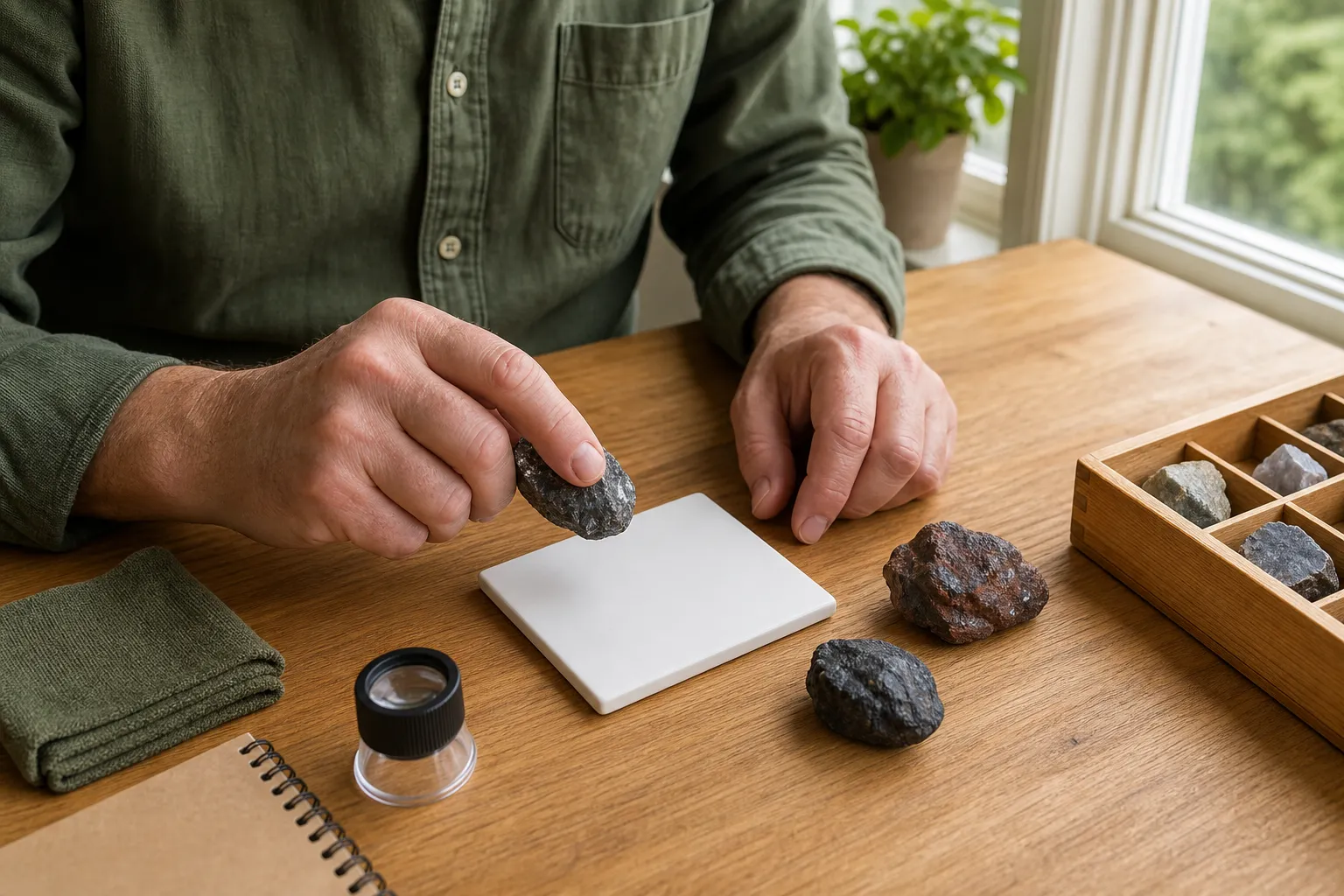
A streak test asks for the color of a mineral in powdered form. Draw a suitable mineral across an unglazed porcelain plate and it may leave a thin line of residue—its streak. That line can be less variable than the color of the intact surface, especially among opaque, metallic-looking minerals.
The useful word is suitable. A streak test intentionally abrades the specimen. It can leave a permanent flat spot, produce an unhelpful mark from the plate itself, and free a small amount of material. It is not a routine next step for every mystery stone.
Use streak only when the specimen is a common, solid, known-safe, expendable mineral and the result can separate candidates already on your shortlist. If you do not know whether the material is safe to powder, do not make powder.
What streak tells you—and what it does not
The National Park Service defines streak as the color of the residue left when a mineral is scratched on unglazed porcelain. It is a physical property, like luster and hardness, but it answers only one question.
Hematite is the classic example. Its intact surface can appear steel-gray, black, brown, or red, while its streak is characteristically reddish. Magnetite generally leaves a dark streak. A pale or colorless mineral may leave a streak so light that it is difficult to see on a white plate.
Those comparisons are clues, not names. More than one mineral can produce a similar streak, a rock can contain several minerals, and a weathered coating can supply residue that does not represent the material beneath it. Combine the result with luster, texture, crystal form, existing breakage, hardness, and heft.
Streak also has a built-in hardness limit. If a specimen is harder than the porcelain, it may scratch the plate rather than leave its own powder. A pale line in that situation can be powdered porcelain. Pressing harder will not turn that result into useful evidence; it will only damage the plate or specimen.
Decide whether to skip the test
Do not streak-test:
- a cut, polished, mounted, valuable, borrowed, historic, or sentimental object;
- a delicate crystal, thin blade, fragile cluster, fossil, artifact, or possible meteorite;
- anything fibrous, flaky, powdery, crumbly, strongly staining, or associated with mine or industrial waste;
- an unknown bright ore, coating, or residue that might contain lead, arsenic, mercury, or another hazardous element;
- a specimen that would need to be broken, ground, filed, or cut to expose a test point; or
- a mixed, fine-grained rock when you cannot tell which grain is touching the plate.
NIOSH documents that processing ore samples can expose workers to silica, lead, arsenic, mercury, and other substances. A gentle streak on a teaching specimen is not the same as industrial pulverizing, but the principle is worth respecting: unknown mineral dust is not casual evidence. Never blow residue from the plate, use compressed air, or brush powder toward your face.
If the object might have scientific, cultural, legal, or financial importance, preserve it and its context. Ask a geologist or appropriate laboratory before performing an irreversible test.
Set up a controlled comparison
Use a dedicated mineral streak plate, not dinnerware, a countertop, or the bottom of a mug that will return to food use. The test face should be unglazed and clean. Work over a stable, wipeable surface away from food, children, and pets.
Before touching the plate:
- Photograph the intact specimen and the point you plan to test.
- Describe its surface color, luster, texture, and visible grains.
- Write down the two or three candidates you are trying to separate and their expected streaks from a reliable reference.
- Confirm that the specimen is an ordinary, known-safe duplicate and that a tiny abraded spot is acceptable.
That last step matters. A test is informative only when you know what different outcomes would mean. “Let’s see what happens” is not a reason to damage a specimen.
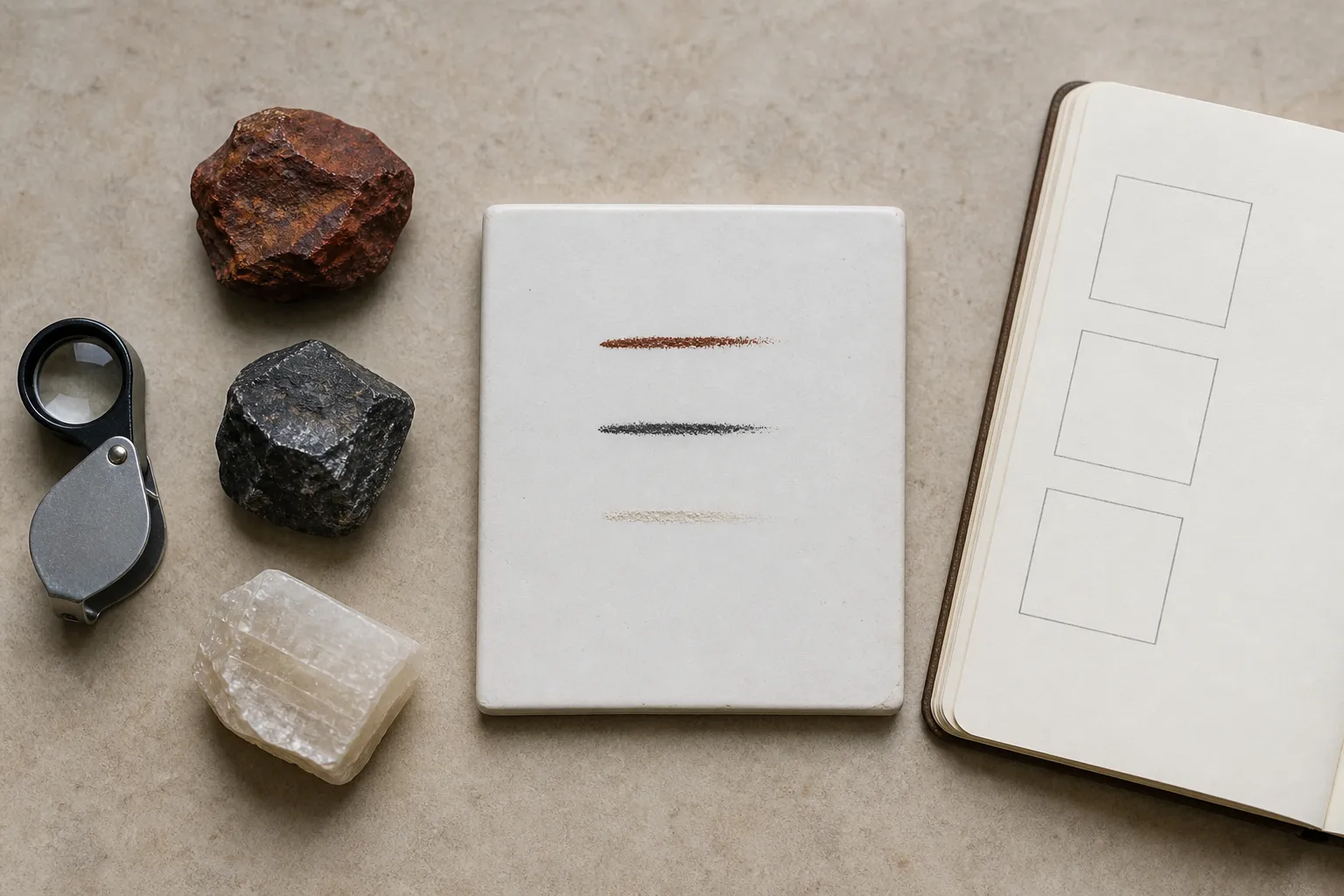
Streak color can narrow a shortlist, but similar lines are not automatic identifications.
Make one small mark
Choose a solid, inconspicuous corner that gives you a secure grip. Hold the plate flat on the table. Draw the specimen across the unglazed surface once, using light, even pressure and a short stroke. Keep fingers behind the contact point.
Stop if the specimen crumbles, splinters, sheds fibers, or needs force. Do not saw back and forth. Do not crush a fragment to obtain a better color.
Observe the line under neutral light. Record the color with ordinary comparisons such as red-brown, gray-black, pale cream, or no visible residue. Also record whether the line looks like loose powder, a groove in the plate, or a transferred coating. A hand lens can help, but do not touch the residue with a fingertip.
For a known-safe teaching specimen, one repeat on a second small area may check an uncertain result. Repeated passes that merely deepen the same line do not add independent evidence.
Read “no streak” honestly
No visible colored line can mean several things:
- the mineral is harder than the plate;
- its powder is nearly the same color as the plate;
- the contact point landed on a different grain or coating; or
- the pressure and surface geometry did not produce a clean comparison.
Record “no visible streak” instead of guessing white. If the specimen appears to cut a groove into the porcelain, treat that as a hardness interaction and stop. Our beginner’s guide to relative hardness explains why a scratch and a transferred mark are easy to confuse.
Clean up without spreading residue
Keep the specimen over the work surface until it is back in its tray or container. For residue from a known-safe teaching mineral, follow the plate maker’s directions; a damp disposable towel can capture the small line without sending dry particles into the air. Do not dry-sweep, blow, or use compressed air. Wash your hands after the session and keep the plate out of the kitchen.
If you see unexpected fibers, abundant dust, strong staining, or crumbling, stop and leave the area undisturbed. Do not improvise a cleanup method for an unknown potentially hazardous material; seek local professional guidance.
Use the result to revise a shortlist
A photo cannot reveal streak because it cannot produce or inspect powder. StoneScout’s ranked candidates and confidence framing are most useful before the test: compare the visible evidence, decide whether streak would genuinely separate plausible matches, and add the safe observation only if it was appropriate to make.
A red-brown streak may strengthen hematite relative to magnetite; a dark streak may push the comparison another way. Neither result establishes purity, origin, treatment, value, or safety. When the consequence of being wrong is more important than satisfying curiosity, stop at the shortlist and move to in-person examination.