
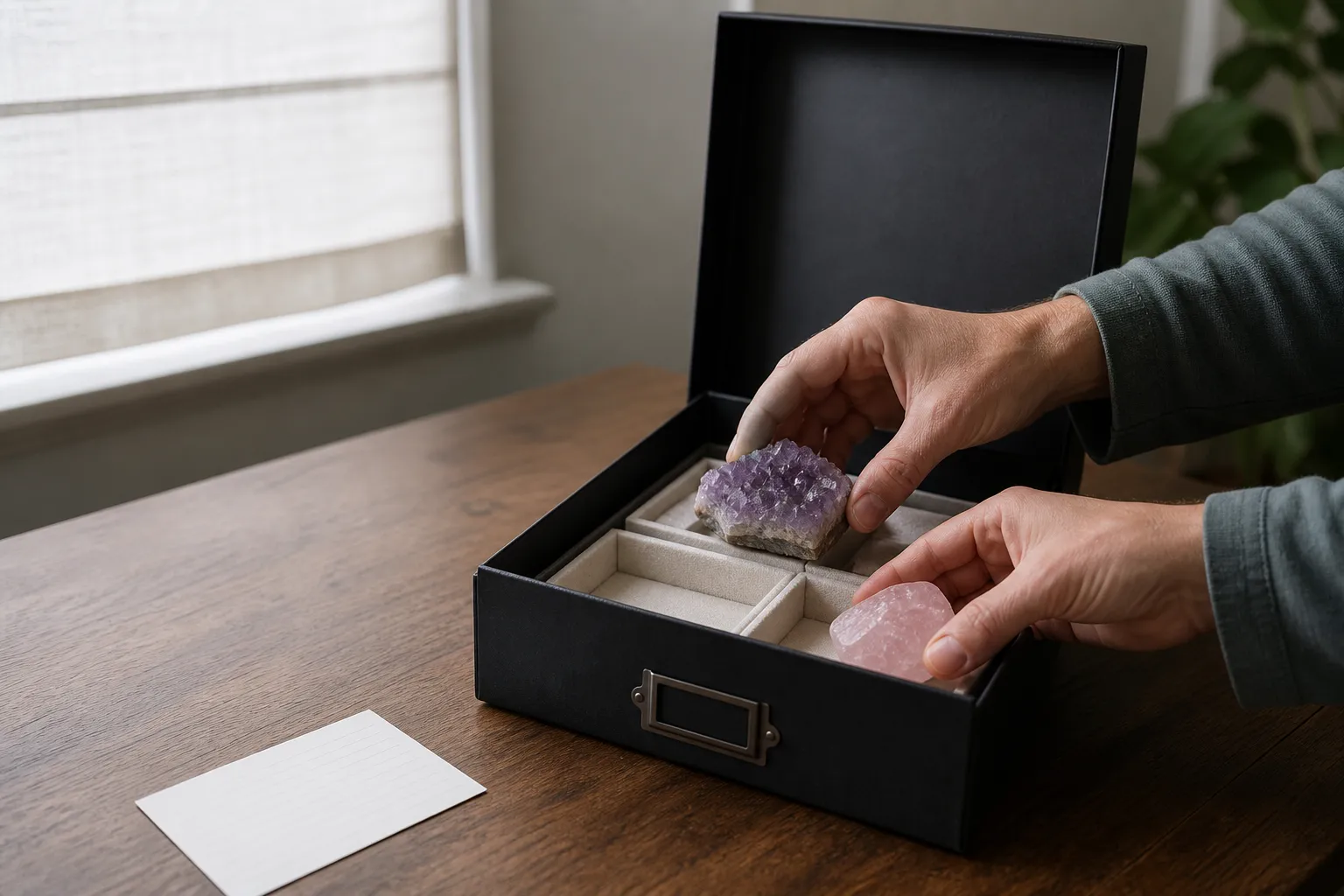
A sunny windowsill can make a mineral collection glow. It can also change it permanently.
Most rocks and minerals are not especially sensitive to ordinary room light, but important exceptions can fade, darken, or transform after enough exposure. The change may be slow enough to escape notice until an old photograph reveals how much color has been lost. Once that happens, putting the specimen in a dark drawer will not restore it.
The safest general rule is simple: keep potentially light-sensitive specimens in opaque storage and bring them out intentionally to enjoy, study, or photograph. A display does not have to be permanent to be meaningful.
Light damage is about dose, not one dramatic afternoon
Collectors often focus on ultraviolet light, but UV is only part of the problem. Visible light can fade color too, and direct sun can add heat. A UV-filtering case may reduce one source of damage without making a bright windowsill safe.
Conservators think in terms of light dose: intensity multiplied by time. A specimen under moderate light for years can receive a larger dose than one examined under a bright lamp for a few minutes. Damage is cumulative and generally irreversible, so both sides of the equation matter:
- reduce how bright the light is;
- reduce how long the specimen is exposed;
- eliminate direct sunlight; and
- turn display lighting off when nobody is looking.
There is no universal number of “safe hours.” Sensitivity varies with the material, the cause of its color, treatments, impurities, prior exposure, and the spectrum and intensity of the light. If a specimen’s history is unknown, cautious storage is more useful than a confident deadline.
Specimens that deserve extra caution
This is not an exhaustive list, and names alone do not predict exactly how fast an individual specimen will change. It is a practical shortlist for deciding what should not live in strong light.
Rose quartz
The Canadian Conservation Institute lists rose quartz among the light-sensitive exceptions in inorganic collections. Its color can fade, so a pink specimen should not be assigned to a sunny shelf merely because ordinary clear quartz seems durable.
Store rose quartz in an opaque box, cabinet, or drawer. For display, choose a location without daylight and limit the hours of illumination. Pale material can be especially hard to monitor by memory, which makes a careful baseline photograph useful.
Amethyst, kunzite, and some topaz
GIA advises that prolonged exposure to intense light can fade amethyst, kunzite, and some topaz. Heat can contribute to color change in certain gems as well. That does not mean every purple quartz crystal will visibly fade on the same schedule, or that every topaz has the same risk. Natural color causes and treatments differ.
Use the uncertainty as a reason for preventive care, not as an invitation to run a test. Do not place one side of a specimen in sunlight to see whether it changes. The result would be damage, not useful home identification.
Amber
Amber is organic rather than a mineral, but it often shares the same cabinet. Strong light can alter its appearance, and CCI classifies it as more light-sensitive than many geological specimens. Keep it away from sunlight and unnecessary heat, and avoid treating its surface as if it were hard crystal.
Realgar and cinnabar
Realgar can transform into other compounds with light exposure, while cinnabar can discolor. These are also hazardous materials: realgar is an arsenic sulfide, and cinnabar is mercury sulfide. Their care is therefore more than a color-preservation problem.
Do not brush, grind, scratch, wash, or otherwise disturb an unknown red-orange mineral to identify it. Avoid creating dust and keep suspect material contained, labeled, and away from food, children, and pets. If a realgar- or cinnabar-bearing specimen is powdery, damaged, or shedding, do not improvise a cleanup or reboxing procedure; isolate the area from access and seek advice from a natural-history conservator, geology museum, or qualified hazardous-material professional.
Make dark storage the default
An opaque, closed enclosure gives a specimen nearly zero light exposure during the many hours when nobody is viewing it. That makes a lidded box or cabinet drawer far more protective than a clear case in a bright room.
Within the enclosure, support specimens so they cannot roll, rub, or shed onto one another. Keep the label with the record, and note any material-specific hazards on both the enclosure and catalog. Avoid attics, vehicles, sunrooms, and other places with strong temperature swings.
When you want a display, use a deliberate setup:
- place it well away from windows and direct sun;
- use the lowest comfortable level of cool, low-heat lighting;
- switch lights off outside viewing hours;
- rotate sensitive specimens back into dark storage; and
- treat UV-filtering glazing or film as an extra layer, not permission for unlimited exposure.
Museum cases sometimes use UV control and low-heat LEDs, yet museums still manage brightness and display duration. Home collectors should do the same on a simpler scale.
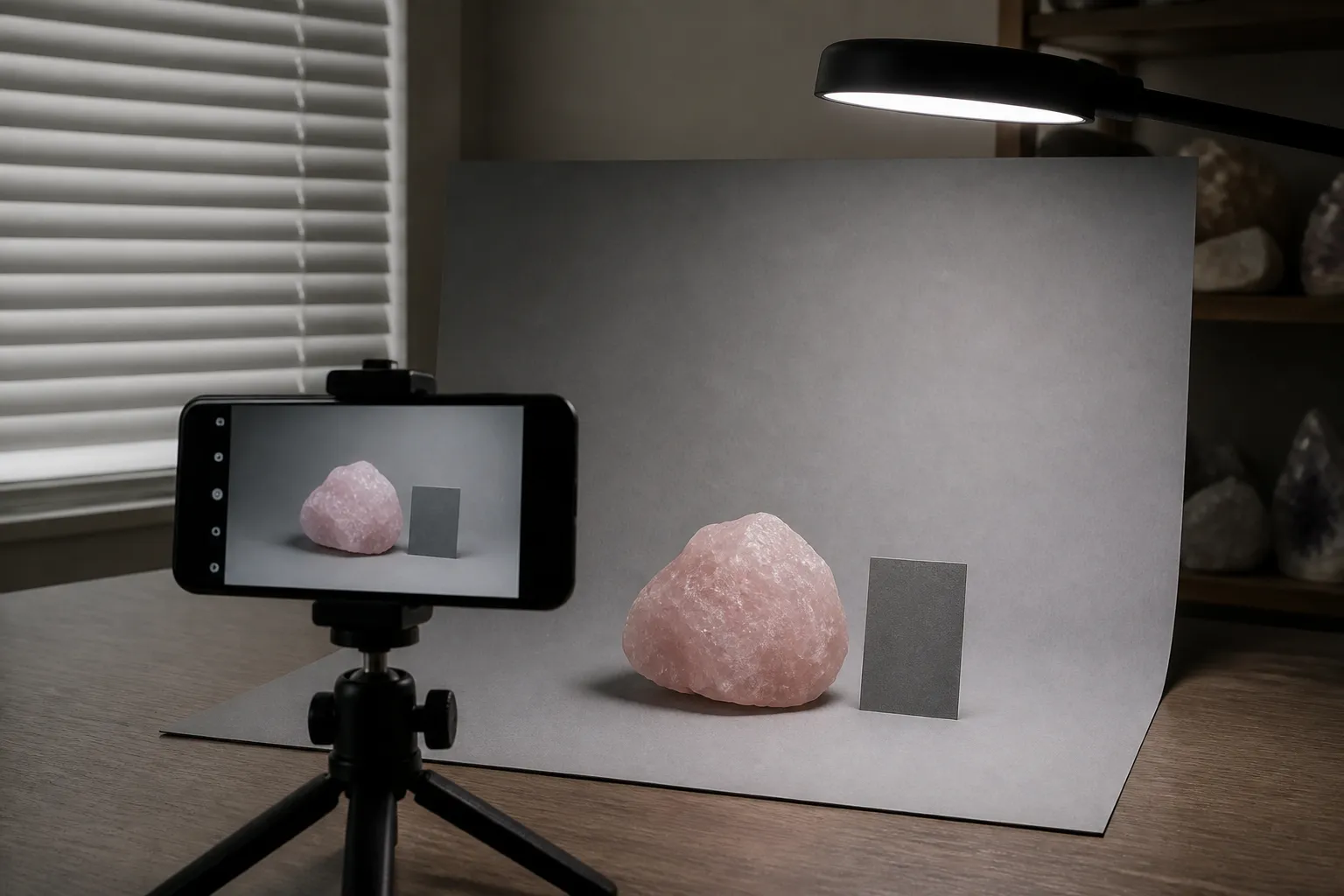
A repeatable baseline photograph makes later comparison more meaningful. Use neutral, diffused light and keep direct daylight off the specimen.
Photograph a baseline before the color changes
A photograph cannot prove that a mineral is light-stable, and comparing casual phone pictures can be misleading. Automatic exposure, white balance, filters, background color, room lighting, and even the screen can all make the same specimen look different.
Still, a consistent record is much better than memory. Before displaying a potentially sensitive specimen:
- Photograph it against a neutral gray or white background under soft, indirect light.
- Include a gray card or color reference if you have one.
- Turn off beauty filters and automatic color effects. If the camera allows it, lock white balance and exposure.
- Record the camera, lighting, background, distance, and specimen orientation.
- Make a close-up of the strongest color and a full-specimen view with its catalog number.
- Repeat the setup at a planned interval rather than constantly exposing the specimen for inspection.
If a repeat photograph suggests fading or discoloration, first reduce light exposure. Confirm the comparison under the same controlled setup, record the date and observation, and seek material-specific advice if the specimen is valuable, hazardous, or actively deteriorating.
StoneScout’s collection can hold multiple photos, captions, and field notes. Save the baseline view, note whether the specimen is normally stored or displayed, and record any change in location or lighting. Keep irreplaceable provenance and condition information in an independent catalog as well.
A one-minute light audit
Walk through the collection at the brightest time of day and ask:
- Does a moving beam of sunlight cross any shelf or case?
- Are cabinet lights left on for hours when no one is viewing the collection?
- Are rose quartz, amethyst, kunzite, amber, or unidentified strongly colored specimens on permanent display?
- Do display cases feel warm or sit near a lamp, heater, or window?
- Are realgar, cinnabar, or other hazardous specimens correctly identified, contained, and documented?
- Does each sensitive specimen have a baseline photo and a known storage location?
Fix the easiest risks first: move the shelf, close the blind, switch off the lamp, or return the specimen to its box. You do not need a museum-grade vault to make a meaningful difference. You need darkness during storage, restraint during display, and a record good enough to notice change without causing it.
Sources
- Caring for natural history collections — Canadian Conservation Institute
- Agent of deterioration: light, ultraviolet and infrared — Canadian Conservation Institute
- Tips on caring for jewelry — Gemological Institute of America
- Gemstone durability: design to display — Gemological Institute of America
- Minerals: sparkling, sensitive and toxic — Natural History Museum
- Curatorial care of paleontological and geological collections — National Park Service